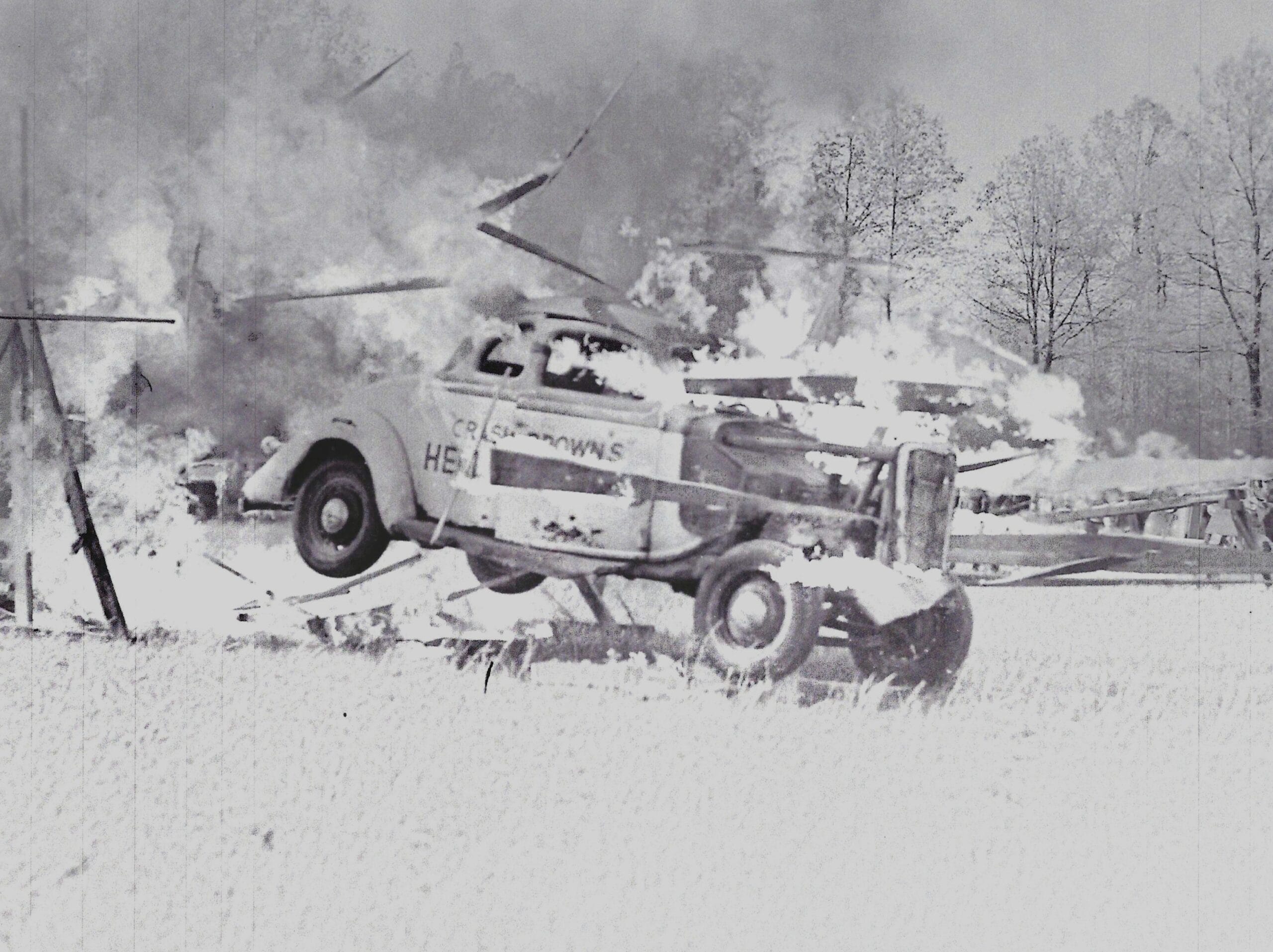
The month of March in Tennessee is noted for its potential for turbulent weather conditions. Weathermen often refer to it as a “transitional” month sporting hints of warm spring temperatures juxtaposed with sharp cold snaps. Tornados and freakish snow storms can take place just a few days apart. March 20, 1920 didn’t spawn either. It was actually a comfortable and calm day where the temperature reached 68 degrees in Nashville. But 70 miles to the south, a young mother struggled to give birth to her second child. By the end of the day, she had delivered a big baby boy that was destined to heat up the atmosphere until the day he died 69 years later. He would come to be known by many names: “The Human Bomb”, “The World’s Greatest Stunt Driver”, “King of the Stunt Drivers”, “The Man Who Originated Thrill Shows”, “World’s Wildest Stuntman”, “King of All Hell Drivers”, “The Helldriver”, “The Human Rocket”, “Colonel”, “Motorcycle Maniac” or the name that seemed to best sum it all up, “Crash Brown”.
John Tim Brown was born in the quaint Lincoln County community of Mulberry. A “spot in the road” that straddles Highway 50, the community in 1920 centered around its picturesque Mulberry Methodist Church.

The Mulberry Church is where Crash Brown first heard the Word of the Lord and it came to him in the form of the thunderous voice of his father, James Thomas Brown. Rev. J. T. Brown was a Methodist minister of some renown throughout Tennessee and Kentucky and following the Methodist tradition, moved frequently from church to church with his assignments. Reverend Brown was the minister at Pleasant Grove and Westmoreland, along with various other churches throughout his career. When the mourners gathered to bury the dead of the Liberty Tornado at Sumner County’s Mt. Vernon Methodist Church in March, 1925, it was J. T, Brown who offered the eulogies for the seven victims who were buried in the church graveyard.
Preacher Brown was a son of Confederate veteran James Peter Brown and his second wife, Nancy Ellen Keen. This marriage produced thirteen children with six boys and five daughters surviving to adulthood. The oldest boy, William Robert Brown, would serve as the Sumner County Sheriff from 1918-1924, its county judge from 1924 to 1928, and in the state legislature as Representative from 1939 to 1941. Like most of the boys of James Peter and Nancy Keen Brown, William Robert Brown and James Thomas Brown were tall and big boned. This lineage would, in part, lead to Crash Brown reaching 6′ 9″ in height.

Crash Brown’s mother was the demure Myrtle Lazinka Creasy, a daughter of Philip Rice Creasy and Nancy Durham. Residents of Pleasant Grove, their farm would later become the homebase for Crash’s array of stunt cars and his “Devil’s Bowl” racetrack. Myrtle’s father was a school board member and a longtime Justice of the Peace. Her mother was the daughter of Pleasant Grove’s Dr. Robert Durham. Myrtle Creasy married James Thomas Brown on July 10, 1903. She faithfully followed her minister-husband in his various appointments and would be noted, through the years, as a writer of eloquent and heart-felt eulogies that would appear in the local papers upon the deaths of family members dear to her. The importance of a good education was stressed to Myrtle by her parents, a trait that she insisted her children garner, as well. It was for this reason many reporters who were to interview Crash Brown through the years would remark at how surprisingly “lettered” he was, often quoting Greek philosophers or passages from the great novelists. And she and her husband both saw to it that her children were well-educated in scripture.

Nevertheless, from his earliest days, it seemed that Crash was determined to “break the mold” of this quintessential Southern Christian family. One can picture him squirming restlessly during the seemingly endless church services that were such an integral part of his upbringing: Sunday mornings, Sunday dinner at the home of a church member, Sunday night services, Wednesday night services, not to mention the frequent revivals preached by his father that sprinkled additional church meetings throughout the week in a time of no air conditioning, starched “Sunday Best” clothes, wooden pews frequently without cushions and the ever-present likelihood of a swift slap from a watchful mother at the least sign of inattentive behavior. A child of a preacher was under a watchful eye wherever they might turn. Crash’s spirit sought a release other than the holy. His would be a life of adventure and thrill seeking.
At the age of 8, John Tim Brown was skipping down a sidewalk when a picture on a drugstore window caught his eye. In it, Erwin “Cannonball” Baker was shown rounding the curve on a racetrack, “Leading the Field”. “Cannonball” was the first winner of the Indy 500 and set many world speed and endurance records in cars and on motorcycles, most famously the iconic Indian line of cycles.

John Tim Brown saw himself in that drugstore picture of Cannonball and he promptly went to work on making it happen. Riding bicycles would later be followed by building and operating “soap box racers” down the winding driveway of Nashville’s Catholic Bishop William Adrian.
During this time, the Brown family lived in the Inglewood area of East Nashville at 1507 Porter Road. It was here that Crash’s father died on the afternoon of May 15, 1932. He had suffered from a progressively debilitating weakening of his muscles for two years. The cause of death was listed as “progressive muscular atrophy”, a degeneration and wasting away of the muscles similar to ALS. The preacher struggled to take his final breath on that Sunday afternoon. Two days later, the family gathered at the Pleasant Grove Cemetery in Westmoreland where five Methodist ministers delivered his eulogy and a score of others served as Honorary Pallbearers.
Crash Brown spent most of his formative years at the family’s East Nashville home, but spent many weekends at his Grandfather Creasy’s Pleasant Grove farm where he loved to hunt rabbits. He attended school at Isaac Litton High School in East Nashville, graduating from there in 1938.
Reporter Bill Holder, in an article entitled Hair Raiser in The Tennessean had this to say in 1948 about the teenage John Tim Brown:

Not long after his graduation in 1938, Crash began hanging around racetracks where he would do odd jobs and hoped to get in on the action. At the time, this amounted to being a “go-fer” in what stood for the pit on the old dirt tracks of the area. Then he briefly attended a school in New Jersey for would-be track drivers, but was dismissed when it was determined he was too young. Not giving up, he next lucked up by becoming a member of the crew of the most famous thrill seeker in America at the time, “Lucky Teter”.

John Tim Brown relished the opportunity he had been given to be a part of such a thrilling road show. “Lucky Teter” was everything John Tim hoped to become. Crowds thronged to see the death-defying events staged by Teter and he was quite the celebrity in the 30s and early 40s when Depression-weary Americans sought cheap diversion from the grimness of their economic plight. During the touring season, Teter and his Hell Drivers canvased much of the area between the Rockies and the Atlantic Ocean, as well as parts of Canada. John Tim Brown had become a traveling man and an integral part of the team.
“Lucky Teter” was actually Earl Teter from Noblesville, Indiana. He was called “Lucky” on account of having survived a horrific car crash in the early 30s. He was a gas station attendant in his home town. After recovering from the crash, he would often sell car polish at local racetracks and fairgrounds and it was while doing this that he was approached by an individual with a rather strange offer: he would be paid $300 cash if he would drive a car that was on display around the track and then flip it over at top speed. Teter accepted the offer and proceeded to wreck the car as requested. Teter emerged from the wreckage unscathed and noted the crowd had been brought to their feet and wildly applauded his stunt. Judging by the reaction of the crowd, Teter reasoned that people would pay money to see more acts like that and his show was soon on the road performing at dirt tracks and fairgrounds in front of large audiences. His safety equipment was no more than a football helmet and a pair of goggles. He sported riding pants and always wore a pair of black boots – the same pair he had been wearing in the crash that nearly killed him a few years prior.
Lucky Teter was ubiquitous: by 1939, newspapers were reporting head-on collisions and reckless driving citations as “Lucky Teters”, he appeared on interviews in radio stations in both large and small markets, he picked up product endorsements, performed at the 1939 World’s Fair in New York, and appeared in a campy movie, Danger on Wheels, starring Andy Devine. Along with him for these events were his road crew, and, at times, John Tim Brown, as a part of that crew, taking on a limited, but growing role in the thrill show. (Brown was actually doing some limited shows on his own when in middle Tennessee, notably at Gallatin, Franklin and Murfreesboro, driving a ’35 Ford V-8, a ’32 Auburn, and a ’27 motorcycle, and he was performing enough with Teter that he was a stunt driver in the World’s Fair performance.)
What follows is the movie Danger on Wheels. In the movie, the stunt driver is nicknamed Lucky Taylor and is portrayed by Andy Devine. In reality, Lucky Teter and his crew, including Crash Brown, are the drivers of the cars and motorcycles in the action sequences. Notice that in some of the scenes, the sides of the cars actually say “Lucky Teter” instead of “Lucky Taylor” as seen in the non-action segments. The action scenes featuring Lucky Teter and crew are from 14:40 to 19:40 in the film.
The good luck for Lucky Teter turned bad in 1942. The world was at war and the nation needed soldiers for the fight. Most of his crew, including John Tim Brown, along with Teter, had enlisted and were scheduled to soon ship out. As a tribute to the war effort, an Army Relief show was to be performed at the Indiana State Fairgrounds in Indianapolis on July 5th. As Teter suited up prior to the show, he could not find one of his lucky boots and was forced to wear one brown boot and one black boot instead of his usual “lucky” black pair. The two hour show went off without a hitch with the crowd spending much of its time on their feet.
The final event of the show witnessed Teter going for a record-breaking 150 foot jump over a line of cars. He had made this jump hundreds of times before, but at a lesser distance. He always took two laps around the track before taking the ramps and jumping over the cars. But for some reason, on this night he only took one lap round the track. Crew members reported that as Teter approached the ramp, his car was not going top speed and the engine could distinctly be heard missing. They tried to wave him off, but Teter leaned back against his seat and proceeded up the ramp and into the jump. As the car hurled through the air, the crew and watching crowd collectively held their breath. Teter’s father turned away and then heard the crash. Lucky Teter fell just short of the receiving ramp, and the heavily-reinforced wood cross bar impaled itself through the windshield and into the face and chest of Teter. It took emergency crews thirty minutes to remove him from the car. In the ambulance on the way to the hospital, the luck of Lucky Teter finally ran out.
Teter’s funeral was a national spectacle with a military honor guard, music provided by the military band from nearby Fort Benjamin Harrison, and among the pall bearers and honorary pall bearers was John Tim Brown.
A little over a month later, John Tim was in Fort Oglethorpe, Georgia where he enlisted in the United States Army. He would spend a total of 44 months in Europe during the war, landing on Normandy Beach on D-Day, and seeing much action against the Germans. He was discharged as a well-decorated Staff Sergeant on November 30, 1945.
Returning to the states, he, like so many veterans, struggled to assimilate back into civilian life. The urge to be a thrill driver soon became overpowering and John Tim Brown began putting together his own show.


Among those in attendance that April day back in 1946 was Sammy Jent. Sammy was a wide-eyed fourteen-year old at the time, and had grown up in a family of “firsts in Westmoreland”: his grandfather, Westmoreland businessman, C. C. Jent, is credited with owning the first automobile in the community, the first bicycle, and the first motorcycle. Sammy’s father, Reuther Jent owned a gas station in town, and his brother, Gordon, frequently raced on dirt tracks in the area. Sammy, himself, later in life, was often spotted flying his ultra-light experimental aircraft in the skies over Westmoreland (making nine forced landings through the years), and once broke his arm while attempting to parasail through Westmoreland behind a dune buggy driven by Jerry Kirby, another daredevil pilot who has been frequently seen in airshows throughout the country.
Sammy recalled the April, 1946 show as being “very well attended” with the road leading to the event “lined with cars and trucks nearly clear back to Westmoreland.”
Crash Brown continued through the summer and fall of 1946 with appearances in Tennessee and Kentucky, often heralded with colorful advertising in local newspapers.


And thus began Crash Brown’s Thrill Show. According to an interview appearing in The Tennessean in 1948, he acquired the name “Crash” from his mechanic “after a particularly resounding crack-up in 1946”. Through the years, his tours from late spring to late fall, would take him to most of the states east of the Mississippi, and the Midwest states on its western side. Many visits to Canada also drew large crowds. Dirt-track raceways and fairgrounds were the sites of most of the shows. Many were sponsored by local dens of the American Legion, and in a time of gravel roads and drive-in theaters, Crash Brown was in demand to stage performances in between the featured films.


Like his contemporary fellow entertainers from a different genre – Elvis and Jerry Lee Lewis – Crash Brown was a larger than life Southerner, and he knew those who came to watch him expected to see “outlandish” in the show. Elvis saw no contradiction in imploring sinners to come home, all while shaking like a hound dog, and Jerry Lee Lewis could pump out “I’ll Fly Away” with the same reckless fervor as he would “Great Balls of Fire”. All three held strong religious beliefs infused in them at an early age by their mothers, and they wrestled with the pangs of guilt as their lifestyles often conflicted with their upbringing. Elvis was banned in many 1950s households when he gyrated on the Ed Sullivan Show. Jerry Lee Lewis was on his way to the ministry when he was kicked out of the Southwestern Assemblies of God Bible college for kicking his piano stool back and turning the hymn “My God is Real” into a boogie-woogie dance number in the midst of the Bible college’s talent show. Crash Brown embraced the term “Hell Drivers” to denote his devil-may-care approach to the high speed, reckless nature of his acts. From jumping cars and busses, to crashing through walls of fire, to blowing himself up seated on a stack of dynamite, to launching himself in a rocket, he nightly flew in the face of death wearing only a jumpsuit of sorts and an aluminum helmet given to him by his mother – “I was the one that bought him that helmet. I seen he needed it,” his mother was quoted as saying in a 1948 interview.

The only thing more relentless than the brutal schedule of touring each year was the tenacity held by Crash Brown in attempting to bring new acts to an audience that was growing increasingly demanding of “something new”. The “ice wall crash”, “the human row bar”, and “the slide for life”, among other acts, were introduced. By the 1950s and the era of the atom, Martians from other planets, and the lure of man’s own traveling into outer space, a man jumping and rolling cars just didn’t have the bang it once sported. As a result, the employment of high explosives became an increasingly important part of the shows.
Crash began billing himself as “the Human Bomb” when he incorporated dynamite into the thrills. He had mastered the art of the explosion by blowing up bridges as a combat engineer in World War II, and such knowledge was again put in practice as a new example of a death defying act. It started with the “Dynamite Casket Act”.

The Glasgow Republican in its July 6, 1950 edition described the casket as a “6-foot assimilated affair, constructed of pasteboard and wood and has no safety gadgets to protect the man from the four sticks of dynamite which he is seated in with.” A later rendition of this act involved the construction of a twenty to fifty foot tower – depending on the location of the event and the inclination of Crash -with the casket resting on an 6ft x 5ft metal plate atop the tower. Crash was secured to the structure with a lone rope tied to one of his arms. His only other safety device was the same helmet he wore for all the other acts along with a pair of goggles. Still later, Crash somehow secured a live vulture that became part of the casket act. The bird would either be tied to the top of the tower or would be on the ground, appearing to await the possible death of Crash. The bird became a pet of sorts, with Crash keeping it well-fed with fish. By the mid-50s, Crash had somewhat sidelined the cars in his show and traveled the eastern part of the country performing the coffin stunt. Advertisements noted he was now using five sticks of dynamite, night after night.
The following interview with Crash appeared in the Memphis Press-Scimitar in November, 1955, highlighting the struggles of the entertainer in impressing the audience:

The Memphis Commercial-Appeal chose to cover the appearance of Crash in the following manner:

But this stint of Memphis performances landed him in a Memphis hospital with serious burns and a near-death experience. It resulted in the cancellation of the rest of his appearances there and this photograph – his “Hollywood Picture” – that was snapped while awaiting treatment in the emergency room:


Less than a year later, a rival stuntman, Alfred Baken, popularly known as “Captain Dynamite”, would be killed performing the casket stunt in Waterloo, Iowa. The 24 year old Baken was noted for using eight sticks of dynamite in his act.
Unfazed, and after a few weeks of recuperation, Crash Brown returned to Memphis where he was feted to ring in the new year:

In 1957, Crash offered an endorsement of his preferred brand of dynamite he used in blowing himself up.
“With me, it’s DuPont Dynamite five-to-one,” he told the Memphis Press-Scimitar. “When I crawl into a box with DuPont Dynamite, I know its going to blow me higher than any other brand.” That same year, 1957, marked the debuting of another way to blow himself up, when Crash created the “Atomic Death Chair”.
This newest device featured a rocket-like contrivance fitted with five sticks of dynamite that slid down a wire that was connected to a chair. Crash would sit in the chair with his head down between his legs. When the nose of the rocket struck the chair, it exploded, hurling Crash upwards of 25 feet through the air.

Though blowing himself up was a common way to draw a crowd during these years, Crash did not fully turn his back on his first love, racing cars. He enjoyed driving in small stock car races in the south and decided to build a track of his own on the family farm in Pleasant Grove. Patterned after the famous “Devil’s Bowl” in Dallas, Texas, Crash opened his “Devil’s Bowl Speedway” in Sumner County in July, 1953. It was immediately a crowd pleaser, drawing drivers and fans to its rural location in large numbers. Most of the races were held on Sunday afternoons but drivers had to operate under strict rules of not racing their engines until the nearby churches at Pleasant Grove had ended their services. As his grandson, David Boner, noted, “His daddy had preached at that church and his mother and brother still attended. He did it out of respect for the Lord and them.”
The country speedway was a dirt track, a 1/2 mile oval affair that sported an optional figure 8 for some races. There was little in the way of fan seating, so the viewers stood on the banks and even in the track’s center in large numbers. Many would run onto the track and over to the scene when a wreck occurred or a car overturned. Cars often jumped the banks of the track, hurling into the woods where they would sometimes get stuck in the surrounding trees. The track was the first of its kind in the area and prominently featured a curve in the front straight-away Crash called the “Devil’s Elbow”.
The following are views of various areas of the “Devil’s Bowl Speedway” from “Crash Brown Without Restraint”, a documentary produced by Twin Path Productions and Cyclemos Motorcycle Museum and Mike Silvio in 2010.


And the remains of the track as it presently looks…


International Motor Sports Hall of Fame member Kenneth Troutt recalled that Crash had built a small tower overlooking the track. There, the announcer, who was often Crash, would speak over a small PA keeping the fans informed of the race status. In his deep, booming voice, Crash was fond of saying, “and now, here comes (the name of the leading driver) leading as they come out of the Devil’s Elbow.” Each time, Crash would place a pronounced emphasis on the words “Devil’s Elbow”.
On one such occasion, according to Troutt, a car came out of the curve and accidentally hooked a long metal cable laying on the side of the track. As the car roared down the track, the cable was whipping to and fro, like the tail of an animal, and as it passed the tower, it wrapped around one of the legs and caused it to collapse and Crash came tumbling down, still holding the mic and roaring quite a few choice words as he hit the ground! (Kenneth Troutt worked in the pit crews of NASCAR legends Darrell Waltrip, David Pearson, Donnie Allison, Sterling Marlin and Rick Mast. He was also a part of the Bobby Isaac crew that set speed records in Isaac’s poppy-red, winged Dodge Charger Daytona in 1970 and ’71.”
The “Devil’s Bowl Speedway” in Pleasant Grove is thought to have been the first dirt track of its kind in Middle Tennessee.
Crash Brown was fond of performances on the 4th of July and on one such occasion, presented a show in downtown Westmoreland. Jim Gammons was in attendance at this event and remembered Crash blowing himself up in the Dynamite Casket, racing a car down Park Street and rolling it, jumping vehicles from a ramp and crashing into cars – the “Kamikaze Dive Bomber Crash” – the “Roman Stand” in which a man would stand on top of a speeding car (an act that would later involve one of his daughters), and Crash laying in the street with a board placed across his body while a 1/2 ton truck drove over him.
And through it all, there was his family.
In the late summer of 1942, John Tim Brown, now a member of the U. S. Army, was enroute to his base on a Trailways Bus. He had fallen asleep, and when he awakened, drowsily discovered the bus had stopped in Copperhill in Tennessee’s Polk County. The air was filled with an almost unbearable acrid smell of sulphur and burning fires. Crash looked out his window and viewed a Martian-like landscape, devoid of most vegetation and shockingly stark in its exposed red clay that was seemingly everywhere. Crash rubbed the sleep out of his eyes, and asked to no one in particular, “Where in the hell am I at?”
The response was one that would change his life.
“My hometown.”
The demure voice that provided the answer was that of Billie Gene Swain. Crash soon forgot about the austerity of the surrounding countryside – laid bare as a result of many years of the burning off of sulphur as a part of the process of the mining of copper ore – and indulged himself in conversation with the pretty brunette who was seated near him. During their journey that day, he discovered that her father had been dead for ten years and that she had buried her mother within the past year. He spoke of the death of his father who had died in the same year as her father, and of the love and respect he had for his own mother back in Nashville. He related accounts of his exploits with Lucky Teter, and his fondness for mechanics while she shared the hardships her family had faced while growing up in the impoverished Appalachian area of southeast Tennessee. That day’s bus ride would take Crash back to his unit and on to Europe and take Billie Gene to Durham, North Carolina and her role on the home front in the war as one of America’s famous “Rosie the Riveters” in a Durham factory. But more importantly, that bus ride was the beginning of a journey of togetherness for the two of them that would last until her death on the eleventh day of October, 1982.

The marriage of John Tim and Billie Gene Swain Brown produced three children, all destined to have roles in the shows of Crash Brown. Daughter Joan would sell admission tickets to the racetrack in Pleasant Grove, while her sister, Billie Jean, would help her mother man the concession stand. Their brother, Phillip, would serve as the manager and perform many of the odd jobs and mechanical duties that were necessary to keep the track running. Together, the three would travel during the show season with their parents, where they became integral parts of the act. The daughters became the “All-Girl Daredevil Drivers” while Phillip served as the show’s clown act, much to the delight of the children and old folks in the audience. Their mother, Billie Gene, would climb aboard Crash’s motorcycle and sit on the luggage rack facing backwards as her husband crashed through walls of flame. Still earlier, Crash had been joined by his brother, Phillip Thomas Brown and his wife, Irene Harden, where they, too, could be counted on to participate in the stunts. It was Philip Thomas who painted the iconic “skull and crossbones” onto the helmets and doors of the vehicles, while also hand lettering the early posters advertising shows, before turning to the famous Hatch Show Prints in Nashville for those printing purposes.


With much of the world’s attention focused on the allure of travel to space, rockets were everywhere in the late 1950s. From comic books to movies to secret government projects, man’s possible travel into space was on the minds of many, including Crash Brown. At his Pleasant Grove farm, he had been busy constructing his own rocket ship, and he announced in April, 1957, that he was ready to take off in his form of the invention:

Crash’s version of the rocket was not so much designed to reach outer space as it was to hurl him into the air and over ponds and other obstacles. It was rudimentary in its design; sheet metal formed the body of the rocket, with a simple, open cockpit for the pilot, and it rested on a metal launchpad attached to wheels so that it might be pulled to the launching site. The whole thing was no more than 20 feet in length. Instead of being fueled by engines primed for maximum thrusting power, it was to be propelled by a tightly wound bungee cord that spring-loaded onto the launch pad. It “flew” on the afternoon of April 28, 1957, in Pleasant Grove. Once launched, with Crash on board, the rocket propelled itself 90 feet into the air, overshot its landing zone, and came down much harder than anticipated, to the surprise of Crash. He summed it up best by saying, “That rocket was pretty dangerous!”. As far as can be determined, the rocket was never flown again, but did see service in area Christmas Parades where Crash would dress as Santa and throw candy from the cockpit as it was pulled by a truck.

In 1958, Gallatin’s James Davis Masters found himself sitting among 5,000 of his fellow sailors of the United States Navy in San Diego, California. They were there, courtesy of the military, to view a surprise show. He, along with the others in the crowd knew not what to expect, when suddenly the doors in a portion of the stadium opened and out roared the cars and motorcycles of the Crash Brown Thrill Show. Masters sprang to his feet along with the other 135 members of the “Grand Ole Opry Unit” from Nashville and shouted with joy at seeing their fellow Tennessean headlining this performance just for soldiers.
For Masters, it was not the first time he had seen Crash in action. He recalled having seen him in Gallatin several years before. On that occasion, young Masters, who was staying with his grandparents, drove himself to the event – in a small buggy pulled by a spotted pony, since his grandparents hadn’t a car at the time.

By the early 1960s, more dirt tracks had opened in the area, having seen the success Crash had with the Devil’s Bowl. When this happened, the crowds grew steadily smaller at Pleasant Grove. In an effort to outshine the competition, Crash enlisted several unusual acts, including wrestling matches. go-cart races, musical performances by the likes of Bill Monroe and Stonewall Jackson, a snake handler, a man famous for catching fired bullets with his teeth, and Cliff Rose, a Hollywood stuntman who advertised he would jump out of a plane and land in the middle of the track. Before doing so, he would throw a dog from the plane and it was told that the individual in the crowd who caught the dog would win $50! As this was about to happen, Crash’s mother and two daughters were watching from their porch nearby and soon noticed their dog, “Jackie”, was nowhere to be found. Much to their horror, they eventually saw Jackie parachuting from the plane and the crowd making a mad dash to catch him. Jackie survived his harrowing experience and Crash’s mother was pretty upset for the next few days, repeatedly noting, “John Tim, you threw my dog out of that plane!”
For awhile, the track included a motor drome, or “wall of death”, an enclosed circular wall in which a rider on a motorcycle would ride continuously in a circle, gradually rising to near the top of the structure before following the same motion back to the ground. A combination of centrifugal force and speed would keep the motorcycle “glued” to the wall and a bright red line would alert the rider that he was near the top where spectators peered from ledges affixed to the outside of the structure.
Father Time and the ravages of repeated injuries began catching up with Crash so that in 1965, he mostly retired from the travel circuit. Any shows that were put on were local in nature. Later, a heart attack, diabetes, and a bout with throat cancer combined to sideline the stuntman. But his later years were not without notoriety.
To make ends meet, Crash was a source for moonshine whiskey when the area was “dry”. And like most who sold it, his customers were a varied lot of both “down on their lucks” and “Sunday Besters” who enjoyed at least a sip now and then.
Gary Adcock relates two humorous events involving Crash in the mid-1960s.
One Saturday night, Gary was slated to take Crash’s daughter, Billie Jean, out on a date. Upon arriving at the house in Pleasant Grove, Gary, who like a lot of folks was fearful of Crash (“he was a big mountain of a man, long hair and facial hair…wild looking”), warily exited his car. Upon doing so, he was greeted by a wildly-barking German Shepard dog and Gary started running toward the front door, thinking the dog was chasing him. Once on the porch, Gary realized the dog had been chained to a line that permitted him to run but stopped him short of the route taken by Gary. Collecting himself from the dog experience, he knocked on the door and was greeted by the booming voice of Crash, “Who the hell is it?”
The ruffled Gary identified himself and stated his business with Billie Jean. “Well, come on in!”, thundered Crash. Upon entering the door, Gary didn’t realize there was a ramp inside, slid and stumbled down the ramp and came face to face with Crash who was sitting at the kitchen table eating a long stick of bologna and crackers, his usual Saturday night routine. Billie Jean then came out and the two soon left on their date.
A few years earlier, Gary and a friend were walking along 31-E on their way to Gallatin. From a distance, they heard a car roaring, rapidly and loudly approaching. They soon realized it was Crash Brown. Thumbing a ride, they reasoned their ride to Gallatin would quickly be over, assuming Crash would continue blasting his way down the road. They were both surprised and disappointed that Crash, instead, drove slowly, with the speedometer never getting over 20 mph. Gary said he thought they would never get to Gallatin riding with Crash.
Another aficionado of cars, Dave Creasy, was both a cousin to Crash and a confidante. Crash told Dave that, over the span of his career, he had crashed exactly 9,543 cars. He kept many of them on his farm and once told a junk dealer, “Ain’t no junk cars out there, son. They are ‘wrecked automobiles.’” Dave said that Crash had great reverence for the cars that had served him during his career. He also saw to it that his neighbors on Pleasant Grove Road, upon their death, had at least one arrangement of flowers at their funeral and that the area funeral homes called him if a resident of the area passed away so that he could see to it that they were remembered in such a way. Dave Creasy remembered Crash driving through the area loudly announcing his upcoming shows over speakers mounted to the roof of his 1957 Oldsmobile station wagon.
It was Dave Creasy who served as the final announcer of the last two shows of Crash’s career. On the 4th of July, 1983, Crash and Billie Jean Brown performed in front of a crowd of 6,000 in Tompkinsville, Kentucky. His final show was at Lloyd McCormick’s “L&L Ranch” on Labor Day Weekend.
Crash’s place also became a museum of sorts. Posters of the glory days of the past adorned the walls of his house and barn. Reporters from newspapers both near and far stopped by for interviews with the showman, and in the 1970’s, comparisons with the daredevil Evel Knievel were inevitable.

And on one summer day, a young David Boner remembers being at home with his grandfather when the the walls of the house started shaking. The roar of an army of Hell’s Angels descended on Pleasant Grove. They were there to see a legend to them; Crash Brown was delighted to spend the afternoon with this crew of motorcyclists who had come down from Indiana to meet with him. According to David, they were intimidating and they were everywhere, there were so many of them, but they were all genuinely respectful and in awe of the legend who regaled them that afternoon with his stories. When they left, they told Crash it would be their high honor if he would mount his own beloved Harley and lead them to the state line. He obliged them and upon reaching the state line, they, one-by-one, honored him with a salute as they passed by.
And speaking of David, his grandson who contributed much to this story, he was the little shadow who couldn’t wait for each summer of his childhood to begin, for he knew that most of those days would be spent with his beloved Grandpa.
And Crash loved every minute of it.
When he turned 4, Crash’s gift to David was a motorcycle:

Crash would teach him many tricks on this bike. David’s mother, Joan Boner, would often warn Crash against teaching his grandson the stunts he used to do. Crash would laugh it off and do it anyway. On one such occasion, when David was 12 years old, Crash suited him up in a ’74 Chevy Nova and decided it was time to teach the child how to perform the reverse spin. Barely able to see over the dash board, David threw the car in reverse, backing down the remains of the old Devil’s Bowl track and just as the car reached 50 mph and Crash yelled, “Turn the wheel!”, David caught a glimpse of his frantic, finger-pointing mother standing on the embankment. Crash just let out a deep and hearty laugh, while David Boner enjoyed another moment with a legend, his Grandpa.

Crash Brown lost his wife, his beloved Billie Gene, in 1982 and he said he never knew what hurt was until he felt that kind of hurt. The “King of the Stuntmen” died a few years later, on the 28th day of February, 1989. He was still 6 foot 8 inches tall and his casket, like the man, had to be larger than life.
It took eight men to walk his casket to the gravesite across from his farm in the Pleasant Grove Cemetery.
Special thanks to David Boner, Joan Boner, Dave Creasy, Sammy Jent, Kenny Brown, Kenneth Thomson, Kenneth Troutt, Gary Adcock, James Davis Masters, Sumner County Museum, Sumner County Archives, and Mike Silvio for the sharing of stories and artifacts used in the writing of this article.
You can learn more about Crash Brown by visiting the Sumner County Museum in Gallatin, Tennessee. The Sumner County Archives also holds a few items of interest related to Crash.
A very informative video of the life of John Tim Brown is Crash Brown Without Restraint, produced by Mike Silvio in 2010.
A few videos of Crash Brown can also be found on YouTube by searching “Crash Brown”.

7 responses to “CRASH BROWN…the larger than life story of Westmoreland’s “King of All Hell Drivers””
I remember hearing stories of “Crash Brown” from different family members when I was a kid. I always thought it would have been really cool to see one of his shows. Thank you for sharing, Mr. Creasy!
Our family lived past Flats story Crask always let’s us kids in free. They were good people, all of the Browns. Good neighbors. As Billy out grew her cloths, some were passed over to me. Oh how I wish this was shareable my brother Benny Blankenship would love to read it. Wonderful memories.
I remember this very well. My grandparents are buried at Pleasant Grove cemetery and decoration was on Mothers Day. You could hear Crash doing his stunts while the service was going on. Also we took donations for for children at Pleasant Grove and I was always afraid to go to his house. We would go anyway and he always gave a donation.
My dad took myself and two brothers to see crash one time, I was probably 6 but remember his show very well
I was at a Crash Brown show at Westmoreland in early 70’s as a child – His daughter was pregnant selling tickets to get in and another daughter was doing car stunts and somebody rode a motorcycle thru a wall of fire it wasn’t crash he was there doing announcements
Wow! My grandfather W E Lyles lived one house down the road from Crash. His farm was next to the Methodist church cemetery. My brother and I walked by his house many times going to Flats store, down the road. He was out in the yard one day and saw us walking down the road and asked us if we wanted to come inside to see his motorcycle. We were hesitant and a little scared because he was a grizzly bear type of man. We did go inside and his motorcycle was in the house. I remember
his son Phillip and Bille Jean his daughter vaguely.
Great story. Remember those days well!