Your cart is currently empty!
A Most Thoughtful Gift
In the Census of 1860, there were 22,030 people living in Sumner County, including what would later become Trousdale County. 14,221 were white, and just under 7,000 were males of voting age. On June 8, 1861, 6,534 of those voters cast votes in a referendum to determine whether Tennessee should remain in the Union or secede and join fellow Southern states in rebellion against the Federal government. 69 of those voters chose to remain loyal to our union of these United States, while 6,465 voted to secede. Clearly, Sumner County was a misguided hotbed of secession.
Throughout the county, military units were being formed to “keep the Yankees out of here”. Along with other local men and boys, my great-great grandfather, Thomas Creasy, fell into line on the “Old Mustering Ground”. Here, in the fields where Eagle Estates and the Moreland Apartments can now be found in Westmoreland, James A. Nimmo, postmaster of the Trammel Post Office, was elected Captain of what would become Company F of the Twentieth Tennessee Infantry Regiment. After a few weeks of training at the Mustering Ground, the command reported to Richland Station and the Confederacy’s Camp Trousdale (Richland Station would later become Portland and, during the Civil War, Westmoreland was known as Coates Town).

Camp Trousdale was a bootcamp of sorts where the men were drilled day and night. Through the summer of 1861, as many as 6,000 men were training at the camp, which had moved from its original location near the depot for the L & N Railroad to a site near the Cold Springs Schoolhouse about two miles to the northeast. Such a large number of men can make a mess of a place pretty quickly, and within a few weeks of the move, measles, diarrhea, and dysentery spread rapidly through the camp. The schoolhouse became a makeshift hospital for the sick while many others remained quartered in their tents due to illness.

In the third week of July 1861, the Twentieth Tennessee, including the local boys in Company F, were ordered to move east to Virginia. The journey was by rail to Nashville, where the citizens treated them to a huge dinner on Church Street, then on to Chattanooga, followed by a stop in Knoxville where they stayed for several days before moving on to Bristol. Before leaving Bristol, their orders were changed to return to Knoxville, and they again found themselves under the command of their Camp Trousdale commander, Brigadier General Felix Zollicoffer (it was said that while at Camp Trousdale, many soldiers accused of being drunk had to prove their innocence by correctly pronouncing – without slurring – the General’s name).

Under Zollicoffer, the Westmoreland boys in the Twentieth Tennessee moved north into Kentucky where they would encamp before engaging with the enemy for the first time at the Battle of Barbourville, Kentucky on September 19, 1861. As a part of Zollicoffer’s command, the Twentieth Tennessee was led by Colonel Joel Battle. The Rebels were victorious, driving the small Union force from the field. The men from Coates Town “saw the elephant” for the first time that day.

A month later, at Wildcat Mountain, Kentucky, they saw their second pitched battle, this time with a much larger force of Union soldiers engaged. The Rebels were unable to drive the Yankees from the mountain, so they withdrew and eventually occupied winter quarters at Fishing Creek, Kentucky.
In each of the earlier battles, the Confederates were armed with antiquated flint-lock guns while the Union soldiers were well-equipped with modern Springfield rifles. This difference in armament would have a profound effect on the outcome of their next battle, the Battle of Mill Springs, Kentucky.
Mill Springs was fought on January 19, 1862 in the midst of a torrential rainstorm. The Confederates found it very difficult to keep their powder dry in such conditions, markedly diminishing their firepower. The percussion-capped Springfields of the Union soldiers were unaffected. By the end of the fight, the Confederates had retreated from the field and a number of men from Coates Town (Westmoreland), were dead or wounded. General Zollicoffer was also killed in the battle.
The defeated Southerners retreated back into Tennessee, traveling along mud-bound roads in a miserable fog of drizzle and cold, and without food or shelter until they reached Gainsboro in Jackson County. Along the way, several deserted, having had enough of the war and its “glory”. After a few days of rest, the men continued their ragtag retreat through Lebanon and then on south, as the Confederate army abandoned Tennessee so as to regroup in northern Mississippi. At Iuka, the men of the Twentieth Tennessee would replace their flintlocks with new Enfield Rifles from England.
Somewhere along that retreat, Thomas Creasy would take a furlough back to his home north of Coates Town on what is today’s Old Highway 31E. His arrival was an unexpected and joyous occasion for the family. But his stay would be short-lived and dangerous, owing to the fact that his Sumner County home was now behind enemy lines. The South had lost battles at Fort Henry and Fort Donelson, and Nashville had fallen into the hands of the Federals on February 25th. Union garrisons now occupied Gallatin and additional troops continued streaming south out of Kentucky. Thomas’ stay, like so many of his fellow soldiers, was likely spent hiding in the barn.
After a few days with his family and as the sun was setting, Thomas said his goodbyes and proceeded south, traveling out of sight and parallel along the road. In the fading light of the day, the eyes can often be tricked into seeing things that are not there. In the one letter the family received from him after his departure, Thomas told of looking back toward his home after walking a few hundred yards and seeing a shadowy figure in the distance darting behind some bushes, as if to hide. Thomas reported that he thought the figure was his seven-year-old son, John Franklin Creasy, trying to slip away with him. Thomas then watched the bushes until he could see them no more in the darkness, then turned and went on his way. In this final letter, he told his family that he felt the apparition he faintly saw might have, in fact, been an omen foretelling that he would never return home.
On April 5, 1862, in Columbus, Mississippi, Thomas Creasy died from complications due to measles. Like so many soldiers in the war, his death did not occur on the battlefield, but rather in a military hospital.
The search for his final resting place would prove elusive to numerous family researchers for nearly a hundred forty years. In the summer of 2000, after discovering information that 2,194 Confederate soldiers were buried in the Friendship Cemetery, the overwhelming majority of whom are simply identified as “Unknown Confederate Soldier”, my wife and I took a trip there with our young daughter in hopes of finding something. It was a long shot but one worth investigating. To our surprise, and after only moments of searching in the section of the cemetery containing the Confederate graves, Thomas Creasy was found.


Mississippi is nicknamed the Magnolia State, and Thomas Creasy and the thousands of other individuals in Friendship Cemetery rest beneath sprawling and massive examples of the beautiful tree. The cemetery is noted as having been among the first to host a Memorial Day observance on April 25, 1866, decorating the graves of both Union and Confederates soldiers.
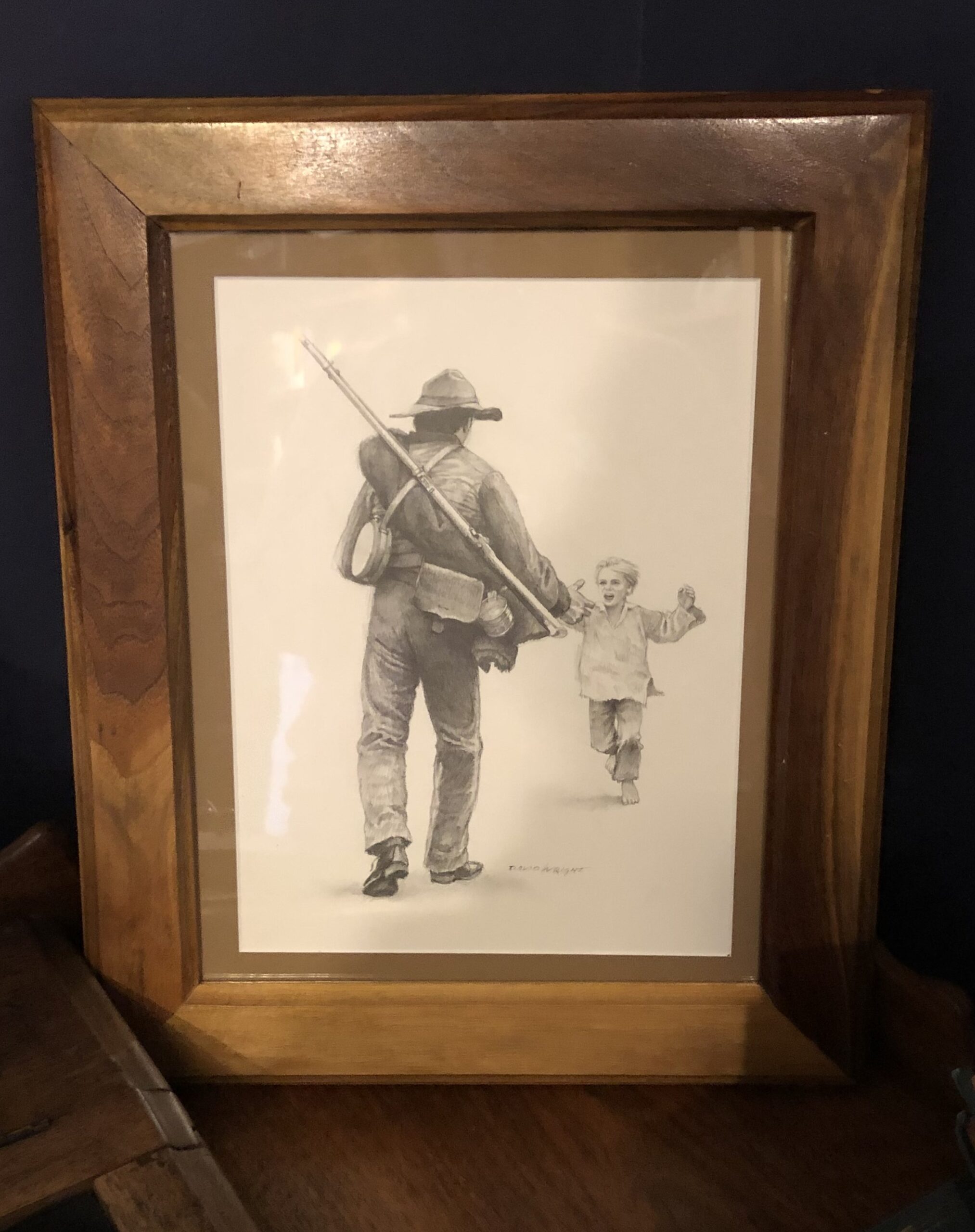
The story of his return home to Coates Town has been passed down through the generations of our family. A few years ago, my daughter Ren, in hopes of having a small drawing made of that long-ago visit, reached out to an artist-friend of mine, David Wright. Speaking on the phone with his wife Jane, Ren mentioned she was in college and didn’t have much money but was hoping to commission a small work. Jane replied that the typical cost for a commissioned work of art was quite a lot but that she would pass along Ren’s contact info to him.
Later that evening, Ren received a call from David.
“Is this Ren?”
“Yes.”
“John Creasy’s Ren?”
Those words began a conversation of reacquaintance in which David reminded Ren of a visit she had made to his studio as a little girl with me. It was a visit where he had walked with her to Asher’s Creek which runs behind his house and studio. There, he laughed as a little girl squealed while feeding the fish that swam in the stream. After reminiscing, he asked her what she had in mind for a drawing. She hoped for a view of that long-ago homecoming between Thomas Creasy and his family. David told her that he would be glad to capture that moment in time, and when Ren asked what the cost would be and that she could pay in installments, if necessary, David informed her there would be no charge. “Your dad and I have been friends for a long time and he has been a good model for many of my paintings. It can be a gift from the two of us.” Ren was overwhelmed with gratitude for this kind act of generosity from such a renowned artist.
As Christmas approached, Ren received a call informing her that the work was completed and on the designated date, she arrived at his studio. A visit to David’s studio is like taking a trip back in time. The rustic cabin houses the life’s work of an individual who is a master of his craft and exemplifies his dedication in attempting to accurately depict a part of America’s story.


On this Christmas visit of a few years ago, David once again led Ren the short distance to the creek where he informed her the last time she had been there she was much shorter and he was not quite as old. They both remarked that the years had flown by since that last visit. They then made the short journey back up the hill where he gave her a tour of the house that is his and Jane’s home. Ren was enamored with the mementos, books, pictures, and paintings that had been accumulated by this preservationist-inspired couple.
Then David presented the drawing to Ren. Today, it hangs as a most-treasured item in my study, along with several other works by my good friend.


One can imagine such homecomings throughout the history of mankind, evoking the same feelings of joy on both sides of conflicts and across all the many cultures that have spanned the globe. For my great-grandfather, the man for whom I am named, that homecoming in 1862 would be the last between him and his father. The remaining years of the war – and the period of Reconstruction that followed – would bring much misery and hardship for the family – including the loss of their mother, leaving the children of Thomas and Louisa Creasy as orphans left to largely fend for themselves.
Today, two direct descendants, Kenny Creasy and Jordan Rippy, still live on portions of the lands that once belonged to Thomas Creasy. Other direct descendants, like my sisters and myself, occupy the lands that were purchased by the children of Thomas Creasy. His direct descendants not only include the Creasy family of this area, but also the families of Jimmy and Roger Brown, James Akins, Charlie Rippy, Delbert Asberry Hammock, John Franklin Smith, William Hodges, Harris and Cleveland Cannon, Will Coates, and many others whose families still call Sumner County “home”.


I am thankful to Ren and David for the kindness of their gift to me. David’s friendship through the years has been a blessing, as well. Recently, his life’s story was told in the form of a wonderful and captivating book, David Wright, Historian With a Brush. It, along with his various works of art, can be purchased online at David Wright Art – An American Artist | American Frontier fine art . I encourage a visit to his site where one will be captivated with his views of local and American history. He boldly captures on canvas the compelling narrative of tragedy and heroism of the people who built the nation.
8 responses to “A Most Thoughtful Gift”
I enjoyed reading this article anything about our history is very interesting and important.John you are a very special writer keep doing what you love!
Thank you, Shirley. I appreciate the kind comments and I’m glad you enjoyed reading it!
Very interesting. Charlie Rippy’s wife Lou was named after Louisa I think.
That might be true. “Louisa” is an old name that doesn’t seem to be much in fashion today.
That made me cry. Thanks for another wonderful story.
Thank you, Jean. I’m glad you enjoyed the read!
Interesting info
Thank you, and thanks to Highland Rim Historical Society for the preservation of the Cold Springs School.