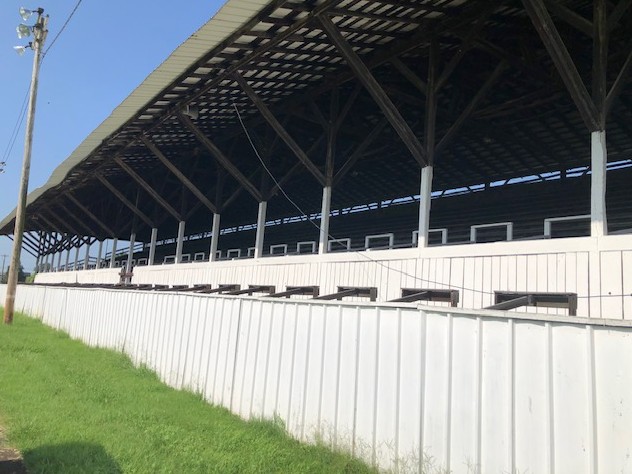
Ironically, it was just yesterday, while driving through Gallatin, that my son noted that it was sad that Sumner County didn’t have a fair anymore. “Macon County has one, and Wilson County’s is huge,” he stated. And today, I discovered the fairgrounds had been sold and will soon be torn down. The City of Gallatin has purchased at least a portion of the grounds and will soon begin construction on a new police station.
I suppose several factors have come together to collectively sound the death knell for the Sumner County Fair. It seems to have disappeared without having been much noticed by us. That’s a sad reality of our 21st century lifestyles. I’m not sure when the last fair was held. I know that during its heyday, Fair Week was marked on the calendars of many local residents. Summer vacations were planned around it, and, for many folks, it was their vacation from the realities of everyday life. Prized garden vegetables were set aside, cleaned and polished for display. Crafts, quilts, photographs, works of art and the like were carefully made and framed and met with the words, “You ought to enter that in the fair!”. Pride was understated but bountiful when such a work was awarded a coveted Blue Ribbon by the judges at the Sumner County Fair.
In the old days, dresses were sewn and, in later years, purchased to adorn the beauties who competed in the various pageants. A select number of households still have that long ago acquired crown and/or silver plate or trophy that proclaimed the lady in her younger years one of the “Fairest of the Fair”.
Certain days were designated as livestock days. Select cows, hogs, sheep and so forth were judged on various qualities and were washed and shampooed accordingly should appearance be something for which the judges were looking. Poultry Day was of great importance for those who raised chickens, ducks, geese, and so forth. Through 4-H, I had become a “chicken baron” of sorts, and greatly looked forward to this day. As part of my agreement with 4-H, I had to select 6 pullets for entrance in the fair. After the competition, some of them would be sold at a poultry auction. It could be hard on a little guy to part with animals who often ate from his hand, but getting a top price for them at the sale felt pretty good. Part of that experience was the emphasis the 4-H program placed on accurate record keeping of expenses and profits. Those simple record books were provided valuable lessons in the costs of inputs and the appreciation of marketing and sales.
One such Poultry Day, in particular, stands out. My friends, Phillip, Victor, and Tracy Jent, had also entered their chickens in the fair. The day was a typical hot and muggy one and we had spent much of it in both the Midway and the livestock areas. When it came time to come home in the early evening, we loaded up our array of chickens in the back of their father’s truck camper shell. Once we got them loaded, Sammy informed us boys that we were too dirty and smelled too bad to ride up front with him in the truck’s cab. So, we rode the sixteen miles from Gallatin to Westmoreland in the bed of his truck cooped up, so to speak, with all our chickens and didn’t think a thing about it.
My mother, Shirley Parrish Creasy, was from Maury County, Tennessee, and 4-H had been very important in her youth. She frequently entered cows, chickens, ducks, sewing and baking projects in their local fair. Once, with the help of her father and brothers, she constructed a model of their small town, Culleoka, depicting several of its houses, places of business, and the church she attended. Small electric poles dotted the diorama, each connected with wires that “electrified” the reconstructed village. The project won a blue ribbon at that year’s Maury County Fair. Her love of 4-H was passed onto us, and she proudly and dutifully preserved all the ribbons we accumulated through the years.
In Sumner County, horse shows and mule competitions were noted for drawing large crowds. People stood along the concrete wall that surrounded a portion of the outdoor arena, and a lucky few were afforded the opportunity to sit in box seats that fronted the grandstands. But it was in the grandstands that most people sat when viewing such events at the fair. And on hot summer evenings, the wooden bleachers could be sweltering, which necessitated leaving them for a bit for the consumption of “fair food”.
Part of the fair experience was cotton candy, corn dogs, funnel cakes, home-baked brownies, giant turkey legs, cheese-on-a-stick, corn-on-a-stick, fried oreos, and freshly-squeezed and ice cold lemonade, to name just a few. With many, the deeper fried specialties were the much-anticipated, “once-a-year” delicacies that were wantonly indulged while sitting in the grandstands, or walking the fair’s midway.
The Midway offered the bright lights that could be seen from afar at night, luring many to “stop at the Fair”. Ferris wheels, Tilt-A-Whirls, the Swinging Carousel, the Zipper, the Vertigo, the Scrambler, bumper cars, giant slides, the Fun House Maze, the Haunted House, and the like adorned the grassy area to the east of the show arena. Also squeezed into the relatively small area at the Sumner County Fair were the many games, each manned by a “barker” whose job was to convince the unsuspecting passerby that they, too, could be the lucky winner of one of the many prized-possessions that were just beyond reach. Many a Sumner County boy spent his pockets dry trying to win a stuffed animal or piece of jewelry for his girl at one of these games. The Ring Toss, Milk Bottle Knockdown, Coins in a Plate, Balloon Darts, Skee-Ball, Duck Pond, Water Gun races, games of strength, and more all convinced the player they had a chance at winning, when often they didn’t. And nothing could be quite so tantalizing as seeing someone else walking around with one of those prizes under their arm.
And now those days in Sumner County are gone. Somewhere along the way, we failed to grasp what others did: Wilson County and Williamson County with their massive, dedicated complexes, and Macon, Robertson, and Clay Counties, and the like, continue to host widely anticipated and strongly attended local summer fairs.
Perhaps no one person or group is responsible for the demise of the Sumner County Fair. The undertaking of a fair is a tremendous coming together of months of planning, behind the scenes lobbying, much footwork, and significant maintenance, all presumably done by a small group of volunteers. In Sumner County, that was likely done by the Fair Board. The volunteers who so ably served the county in that position, and others in supporting roles, slowly died off with few people willing to replace them.
The facilities have fallen into significant disrepair and have become dangerous. The grandstand steps are rotting with nails popping through the flooring. The roof rests on fragile posts and the inevitable creep of vines has made a serious invasion along several of the walls. The concrete fence that stands along the arena has collapsed in some places and the wooden fence rails are weathered and more chipped than painted. The livestock building is beyond its lifespan. Sadly, sometimes a place just cannot be saved due to the cost to the taxpayers.
Interestingly, for a number of years, the largest fair in Sumner County was actually held in Westmoreland.


Beginning in 1931 and running through 1952, Westmoreland High School and its Agricultural Department played host to the East Sumner Fair. Initially started by N. H. Baulch, the school’s Ag teacher, the fair grew in size each year and was usually held over a two or three day span in late August or in September.


Westmoreland’s East Sumner Fair was centered at the old Hilltopper school on the corner of Bledsoe and Locust Streets. All areas of the building were used to accommodate the fair with speeches, pageants, and concerts held in the auditorium (including one of the last speeches given in his home district by the Speaker of the United States House of Representatives, Joseph W. Byrns (for whom Jo Byrns High School is named) in 1935. The grounds around the building held the ferris wheel and other rides and games of the Midway. The final Saturday evening activities shifted to the City Park in Westmoreland’s downtown, where thousands attended multi-ring horse and mule shows.
And now, gone the way of many a drive-in theater, skating rink, bowling alley, full-service gas station, evening front porch conversations with neighbors, family farms, the Sumner County Colored Agricultural Fair (the first of its kind anywhere in the US), and the East Sumner Fair, the Sumner County Fair, too, becomes a thing of memory. I’ll leave you with a few last glimpses of what will soon no longer be:


4 responses to “The Passing of the Sumner County Fair”
While I didn’t grow up in Sumner County, I helped for years with the youth entries, working with 4-H. My children entered their crafts, chickens, and helped to build booth displays in the Floral Hall. “Kids Day” was looked forward to, to win some money to then spend in the Midway. I wish we could somehow, somewhere open a new Summer County Fair! The county needs to study on how to bring back this much missed attraction! I still work for 4-H and we’ve discussed how we could possibly put it together. The youth of today don’t realize what they’re missing!
Thank you for reading, Diane. I wanted to share this story for the very reasons you cited!
Good article
Thank you, Paula!