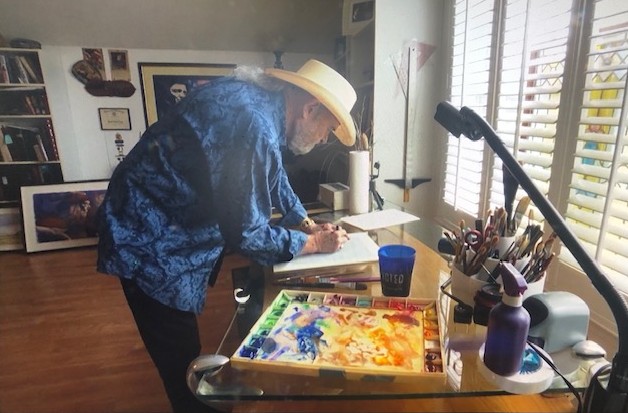
Chuck Creasy is an artist, and he’ll be the first to tell you there’s not much that’s glamorous about it. That’s a combination of both his self-deprecating style and his “oh shucks” view of the astounding talent he possesses. A tour of the home studio of this artist from Westmoreland reveals a lifetime of chance that often opened the door to remarkable opportunities for creativity.
And it had its beginnings in Westmoreland!
Or, should I say, just down the road a piece, for Chuck was actually born in Fountain Head, just south of Portland at what was then called the Fountain Head Hospital, in November, 1946. But his family was from Westmoreland, he spent much of his childhood here, he frequently returns, and when he talks of “home”, Westmoreland holds that spot in his heart.
His parents were Charles E. Creasy and Vernie Dee Simpson Creasy. Both were born and raised in the northeastern part of Sumner County. Westmoreland was the home of his paternal family. His grandparents were Willie Thomas Creasy and Neeli Myrtle Goad Creasy, and his great-grandfather was John Franklin Creasy. As a boy, Chuck lived with his parents in a house built by his great-uncle, Paul Wesley Creasy, on Old Highway 52. The small farm and house his parents resided in was just up the road from his great-grandfather’s farms, and not more than two miles from the farm of his grandfather on Bishop Troutt Road. These places would be instrumental in the development of the young Chuck Creasy, and would be places he enjoyed returning to as the years progressed.

Chuck’s father, like so many of his generation, returned from service in World War II and proceeded to start a family. His brothers, Fred and Claude Creasy, did the same. Charles E. Creasy served in the US Navy.


But Westmoreland proved to be a difficult place to make a living, owing to a lack of jobs, and Charles E. Creasy reluctantly moved his family to Nashville in the mid 50s. It was there that Chuck Creasy, the future artist, discovered his love for the canvas. His first formal art lessons began when he was nine years old. His winning several awards at this young age served to truly ignite his passion. His graduation from high school in 1964 eventually led to his admission to Cookeville’s Tennessee Tech University, where he attended until his having been drafted by Uncle Sam in 1966 (a quarter of not having been the best example of “studious” landed him on academic probation, at which point Uncle Sam grabbed).
With war raging in Southeast Asia, many young men found their lives interrupted by the draft and Chuck did not dodge or claim bone spurs and the like to avoid service. After Basic and AIT, Chuck was chosen for Officer’s Candidate School in Fort Sill, Oklahoma. He graduated as a 2nd. Lieutenant and was later sent into the jungles of Vietnam. There, he was an artillery forward observer with B Battery, 3rd Battalion, 82nd Artillery, as well as Bravo Company of the 96th Light Infantry Brigade. As Chuck recounted in Vietnam: 2 Soldiers 2 Artists 2 Journeys Then & Now: The Vietnam Art of David Wright & Chuck Creasy, “the unit was humping the boonies at least three weeks a month, living on the ground, digging in each night and sleeping in the bush. It was a nasty assignment, especially considering the life expectancy of a forward observer attached to an infantry company was a mere two and a half weeks.”


While there, Chuck was attacked by the enemy of disease; malaria, dysentery and jungle rot plagued him, and when felled by a serious injury, he was sent home four months before the end of his tour and was later discharged. He was welcomed home by his family, now including his parents and two siblings, along with his wife and son.
Before being sent to Vietnam, Chuck met the love of his life on a blind date at Tennessee Tech. Following his graduation from Nashville’s Maplewood High School, Chuck traded his ’59 VW Bug for a ’56 Chevy. He treated it like a pet and it was the envy of a lot of folks. He got the blind date because he had a car and the other guy didn’t. Chuck fell head over heels for that blind date, a fellow Sophomore, Marnie Davis. The feeling was mutual, and after a few months of dating, the two began making permanent plans. Following a summer of work, the two were married in September, 1966. They rented an apartment in East Nashville and were promptly interrupted with Chuck’s draft notice a month later.

In Vietnam, on Christmas week, 1968, Chuck and his unit were out of the field back at their support base for a week of rest. Late in the night on a lonely Christmas Eve, Chuck was called to report to Headquarters. Upon his arrival there, he was greeted with the words, “We’ve just had a ham radio operator out of Nashville, Tennessee call us to tell you that your son has been born.” The Tennessee radio operator, Ernest Allen, was a fellow church-goer who had been working his radio all day in an effort to get the message to Chuck. Chuck received official notification from the Red Cross three days later.

While in Vietnam, Chuck mulled over what his future might be upon his return to the states. It was in the jungles of Southeast Asia that he determined to pursue a career for which he had great passion, painting. After his return to Nashville and discharge from the service, his father asked Chuck what he was going to do, suggesting a return to school. Chuck pitched that he was going to go to art school.
“You’ll starve to death,” his father replied.
And the next few years were financially challenging for the young family, but Marnie fervently supported the endeavors of the man she loved. Chuck hated his classes focused on architectural engineering at Tech and became, instead, a student at Nashville’s Harris School of Advertising Art. The school offered a three year program of studies in ad design and fine arts. Among its distinguished graduates is Bill Holley, the designer of the iconic “Uncle Herschel” Cracker Barrel logo, and David Wright, nationally-recognized painter of the American Frontier. Chuck would make life-long connections at Harris.

During the summer following his first year at Harris, Chuck Creasy enrolled in a course of summer studies at Woodstock, New York instructed by John Pike, a renowned Watercolor artist. Chuck fell in love with the medium and felt he had truly found his calling under the direction of John Pike, who would become a mentor to Chuck. The following summer, Chuck returned to the Watercolor School in Woodstock for another round of intense instruction. It was there, in 1970, and over a shared bottle of wine, that John Pike suggested to Chuck, “You should go see Norman Rockwell.”
The suggestion shocked Chuck.
Chuck had mentioned how much he admired Rockwell’s works and Pike, who knew the artist well, called his friend and told him he was sending a young guy and his family to meet him. Rockwell replied, “Yeah. Send him on over.”
The next day, Chuck, Marnie, and Chuck, Jr. loaded up their VW camper van and drove the seventy miles through the Hudson Valley and into the Berkshires and Stockbridge, Massachusetts, where Rockwell lived. The first place they stopped was a local store situated on the town’s main street depicted in Rockwell’s 1967 Home for Christmas. Asking for directions to the house of the artist, Chuck recognized the store worker as having been a model in one of Rockwell’s paintings. The family soon found themselves knocking on the front door of the “big white house on the corner”, the Rockwell home on South Street.
When the door opened, Molly Rockwell answered the knock with, “You must be the young family John Pike was telling us about.” And with that, they were invited in for tea where they spent the next hour talking with Rockwell’s wife. After a long while, the artist finally appeared and he immediately wanted to know about Tennessee. Eventually, Chuck heard the words he longed for, “Come out to the studio with me and we can talk art.”
Rockwell’s studio in Stockbridge had become “his best studio yet” in the late 1950s. It was originally an ancient carriage house, long neglected and run down, prior to its restoration as his art studio. Marnie remained back at the house with Molly, while Chuck and Chuck, Jr. were taken to the studio. Once there, Chuck noted the various paintings stacked around the walls and the artist’s chair, easel, canvas and pallet of paints. In one corner was a rocking chair upon which Chuck, Jr. quickly perched, rocking wildly as little ones are prone to do. “Leave that boy alone,” was Rockwell’s response to a worried father. The rocker had been a gift from fellow artist N. C. Wyeth.

Norman Rockwell was so impressed with Chuck Creasy’s zeal for learning that he invited him to spend what turned out to be the next two days with him in his studio. The American icon showed the wide-eyed young man from Westmoreland his whole process he used in his paintings; his various techniques, use of lighting, stories behind some of his most famous images, and the emotional toll such a dedicated career could take on personal relationships were all topics for discussion. Chuck found the artist to be open, honest, and humble throughout the three day visit.
Those three days helped to confirm Chuck’s destiny. Chuck had walked into Rockwell’s studio with the possibility of becoming an illustrator, a title the Stockbridge artist proudly bore. But of a career in illustration, Rockwell told Chuck, “The golden age of illustration is about over and not many of us are left. The camera is taking over and if I were you, and I wanted to get in the field, I would look into Design and Advertising, in that area.”
Chuck found Rockwell to be unassuming and self-deprecating, attitudes confirmed through the years by those who knew him. When Chuck noted he was a living legend, Rockwell shrugged his shoulders and simply stated, “Oh, hell son, I just paint.” While in the studio, Chuck lit the famous pipe of the artist and handed it to him while he painted. And when asked how an individual could make a living doing that kind of painting, Rockwell noted, “You’ve got to absolutely, completely sell out and make that the focus of your life.” On their way back to Tennessee, Chuck told Marnie, “It’s not something I can do.”
But he’s spent the rest of his life proving that, indeed, it was something he could do.


Once back in Tennessee, he resumed his studies at the Harris School and he picked up a nighttime job to provide for his family. He would be in class all day, stop briefly at his apartment for a few precious moments with his family, and then head out the door to wait tables at Nashville’s new Brass Scales Restaurant. It was here on one such shift that a lone couple lingered at their corner booth past 1 in the morning, clearly prolonging Chuck’s shift. When asked if they needed anything else, the gentleman requested Chuck to have a seat, whereupon he reluctantly obliged. During the course of the conversation, Chuck shared that he was a would-be artist, which served to pique the interest of the gentleman who then revealed himself to be Eric Ericson. He told Chuck that he had some experience with ad agencies and that he was in the process of launching a new agency in Nashville. To Chuck’s great surprise, Ericson asked him to bring his portfolio by his office the following Monday for his review and possible employment. An excited but skeptical Chuck showed up at the address as requested. His portfolio, in fact, only consisted of three small drawings fitted into a Harvey’s Department Store sack.
“That’s it?” Ericson naturally asked.
Chuck was elated, however, when Ericson said, after carefully studying the diminutive example of work, “Pretty pitiful. But I like you and I think you’ve got tremendous talent.” In a stunning chance of fortune, Chuck Creasy had landed his first advertising job with what would become the legendary agency of Eric Ericson & Associates. Chuck’s excitement was so great at this news that he hurried to the nearest pay phone to tell his wife. After congratulations, Marnie questioned the amount of salary the job brought. “I don’t know. I didn’t ask him.”
Hearing this news, Marnie’s excitement dimmed and she insisted her husband call Ericson for the answer. Ericson’s blunt reply was, “It doesn’t matter. Son, whatever I pay you, you should be grateful. I’m putting you through what amounts to Grad school for a year!” And, in effect, he did. Though the salary would amount to around $6,500, the job afforded the opportunity for Chuck to build a substantial professional portfolio and to catch the eye of others prominent in the industry. He would remain at Ericson’s for about two years when he was lured to a succession of competing agencies over the next several years that followed, each offering him a “doubling of salary”. This led to creation of his own design studio, “Chuck Creasy Creatives”, located off Nashville’s Music Row, where he concentrated on album covers and the like. This opened the door to a connection with Tom Bell who was doing work for the Reagan Presidential Campaign in 1976. He enlisted Chuck’s help in the creation of campaign posters that appeared in that unsuccessful run. In the years that followed, Chuck was lured back to Ericson & Associates where he became Associate Creative Director with significant salary increases. His stint there would last several years until he was offered the opportunity to become a creative director for the ’84 re-election campaign of Reagan/Bush. (In the meantime, Chuck had similarly been responsible for the two gubernatorial races of Lamar Alexander in Tennessee.)
Chuck’s role in the presidential election of 1984 required him to spend much of that year in the nation’s capital and various other spots with the Reagan Campaign. He was teamed with Nashville photographer Michael W. Rutherford. Chuck noted that their first arrival at the White House resulted in less than desirable fanfare. According to Chuck,
“Mike and I, along with his assistant, drove our car, loaded with photographic equipment, to the front gate at the White House. A marine approached the car and asked us to state our business. Mike, who was driving, replied, ‘We’re here to shoot the President.’ You cannot begin to imagine the response that kind of answer will get you at the White House! We were quickly surrounded and, even though we explained “shoot” meant to “photograph“, our car, the equipment, and our persons were thoroughly searched. Only after that were we permitted entrance.”
The photography sessions at the White House included one on an 18 degree day. To photograph the president, Mike and Chuck had to get past Chief of Staff James Baker, and on this particular day, that would prove difficult. Baker eventually permitted them a 5 minute window of opportunity to get their “shot”. Much to the chagrin of Baker, when President Reagan appeared, he insisted on a few minutes of small talk before the session began. Chuck found him to be quite affable in talking about Tennessee and mutual friends they might have. Finally, the president said, “What do you boys have in mind?” regarding the photo op. Mike and Chuck suggested an outside shot of the president walking along the famous West Colonnade just outside the oval office. Reagan replied, “That sounds great. Let’s do it.” During the shoot, which took considerably longer than the 5 minutes allotted by Baker, the actor came out in the president and he repeatedly asked, “What do you need me to do?”. Eventually, an exasperated Baker said, “That’s it. Break it down and close it up.”
But Reagan was not through. He said, “Son, do you have what you need? Let’s just shoot till you guys are happy.” Mike and Chuck found out later that James Baker was on edge owing to the fact that the president was being delayed to a meeting with the Joint Chiefs of Staff. Incidentally, after the shoot was finished and Mike, Chuck and the assistant were breaking down the equipment, they witnessed Reagan leave the Oval Office to step out onto the adjoining patio, reach into his suit pockets, and toss out a bunch of hickory nuts to the squirrels, again, further delaying the meeting with the Joint Chiefs.
During the Republican National Convention in Dallas, Mike Rutherford as photographer and Chuck Creasy as Creative Director were afforded complete access to the private suites of Ronald and Nancy Reagan for a behind the scenes look. On the occasion, Chuck noted the affable Reagan greeted them with a hug and the words, “There’s my buddies from Tennessee!”


Chuck Creasy’s role as creative director for national print advertising, collateral and design with the Reagan / Bush ’84 campaign would lead to similar roles in the presidential campaigns of Lamar Alexander and George W. Bush.

During it all, Chuck created a “little boutique / creative design shop” on Nashville’s Second Avenue. This solo venture initially involved only one other employee, his wife, Marnie, and no clients. But reputation can go a long way and by the end of its first week in existence, “Chuck Creasy Creatives (II)” had signed seven clients. The business flourished for several years and became the de facto “go to” of local public relations powerhouse Dye, Van Mol, and Lawrence (DVL) in the outsourcing of the portion of their campaigns involving advertising. A few years later, the founders of DVL, Hank Dye, John Van Mol and Tom Lawrence, walked down the street to Chuck Creasy Creatives with a bottle of Jack Daniels and a business proposal. By the end of the meeting, little of the Jack was left and Chuck Creasy had become the fourth partner of DVL, launching a design agency within the PR firm. For the next eleven years, Chuck and DVL would play a significant role in the branding of such heavyweights as Jack Daniels, Smuckers, Tractor Supply, Bridgestone and the like. At DVL, Chuck oversaw a creative team of 30 professionals and his reputation excelled.
And then he left it all behind.
At least for awhile.
Chuck and Marnie had become avid scuba divers under the tutelage of Dave Bennett, the Tennessee transplant who owned the Turneffe Island Lodge off the coast of Belize in Central America. Trading out advertising of the resort for free visits, Chuck and Marnie were frequent visitors at the island and had similar arrangements with other enterprises in the Caribbean, as well as the owner of a110 foot trimaran dive boat. The collective influences of these ex-pats lured Creasy away from the business world to the beach life. The couple bought a house on the beach in Florida’s Mexico Beach community and for the next four years, Chuck professionally pursued his first love, the painting of watercolors. He did well there, surrounded by “Old Florida” – oystermen, rustic shrimp boats, lighthouses, and such – selling his prints to locals and visitors alike and developed quite a following. But Marnie eventually grew homesick for the hills of Tennessee and the couple returned to Nashville, where Chuck wondered what he would do in his semi-retired condition.
He didn’t have to wonder for long.
Butch Spyridon called with the semi-rhetorical question, “What are you going to do, Chuck?” And then he proceeded to supply the answer, “Why don’t you come up and join the team at the Convention and Visitors Bureau as Creative Director.”
And with that, Chuck Creasy, courtesy of another chance encounter, had launched the newest facet of his career.
The Nashville Convention and Visitors Bureau was tasked with the responsibility of selling Nashville to the World. Spyridon had been the energetic visionary force behind the promotion of Nashville and, for the next eleven years, Chuck Creasy and his team of creatives would bring that vision to life. Together, they and their staffs would bring to vibrant life the successful theme of “Nashville: Music and More”.

Drawing upon Nashville’s musical roots, Chuck recalled another chance encounter from his past that would contribute to his future. As an eleven-year old boy, Chuck worked at the Ryman Auditorium and its Grand Old Opry. On one particularly hot night in the summer of 1957, a tired Chuck rested in the alleyway between the Ryman and the famed Tootsie’s Lounge. His job was to sell popcorn, peanuts and Cokes and he had about ten bottles of the beverage in the wooden Coca-Cola tray setting beside him on the dingy sidewalk. Out of the side door leading to Tootsie’s, a “half tanked-up” Johnny Cash stumbled out and quickly discovered the resting boy. Cash was a giant of a man but he sat down next to the diminutive Chuck and asked, “What are you doing, boy?”
Chuck simply replied, “I’m just sittin’ here, taking a break, selling Cokes.”
“How much are those Cokes?” Cash asked and Chuck told him they were a nickel apiece. Cash pulled out a $20 bill and told Chuck he would take them all. A surprised Chuck noted he didn’t have the change for a twenty, whereupon the entertainer told him, “I don’t want the change.”
The two spent the next 15 minutes or so making small talk – a country music giant between sets at the Grand Ole Opry and a little country boy selling Cokes – in that alleyway next to Tootsies. Many years later, while working on the set of the “Johnny Cash Show”, Chuck spoke again to Johnny Cash and when asked if he remembered the conversation on that summer night in 1957, the Man in Black replied to Chuck, “Hell, I don’t even remember 1957!”
In his role with the Nashville CVB, Chuck rubbed elbows with many members of the city’s colorful array of musical entertainers. He would frequently call on them through the years to help in various projects. One of those projects has become an iconic symbol of the city.
The Dixie Flyers had, for a number of years, been somewhat of an oddity: they were an ice hockey team in the South when air conditioning was still a luxury. From 1962 to 1971, the minor league team skated on the makeshift ice rink in the Municipal Auditorium. After their demise, they were followed first by the Nashville Knights in 1989, and then the semi-professional Nighthawks / Ice Flyers, briefly thereafter. Rumors began to circulate in 1995 of interest in bringing big league hockey to Nashville.
It takes a lot of work for a community to land a professional sports franchise, and a Southern football town securing an NHL team seemed to border on pure madness. After failing to lure the existing New Jersey Devils in 1995, the city’s efforts were bolstered by Wisconsin businessman Craig Leopold who led a group attempting to secure a possible expansion team. This effort, along with the failed New Jersey Devils attempt, caught the attention of the NHL. Nashville made the short list of possible expansion cities in the summer of 1997.
On a mid-summer’s eve in 1997, Chuck Creasy, along with Nelson Eddy, Chuck’s Associate Creative Director at DVL, attended a party thrown by Craig Leopold where the president of Nashville’s unnamed, non-existent, no-arena and unawarded hockey team would be announced. There, Jack Diller was named as the president of the franchise that existed only on paper.
When the official introductory party for Jack Diller ended, he, Chuck Creasy and Nelson Eddy extended it into the wee hours of the following morning at a table in Tootsie’s Lounge. It was there that Diller said, “You know, I like you two guys, and we’re going to have to have an agency…”
Cue the next chance encounter that would enhance Chuck’s future.
The drinks at Tootsie’s led to a ten-year relationship between the Nashville Predators and Chuck Creasy and his staff of creative artists. Ultimately, they were responsible for the creation of the iconic Predators logo, much of the design and storyline behind Gnash, the mascot, and many of the traditions that have become synonymous with “Smashville”.
But before all of that, Chuck and company were awarded the task of creating a desire among Nashvillians to even want a hockey team. To do this, Chuck came up with a parody of sorts of the famous “Got Milk” ad campaign. Calling it “Got Tickets”, instead, Chuck created a series of print ads that ran throughout the summer of 1997 that featured well-known Nashvillians staring into the camera’s lens while holding a hockey stick.

“Got Tickets” was wildly successful and resulted in the selling of 10,000 season tickets to Nashvillians and Middle Tennesseans to see a non-existent NHL team. The Predators have been turning Nashville into “Smashville” ever since.
On the heels of the successful Predators campaign, Chuck Creasy led his creative team in the creation of the 2013 documentary For the Love of Music: The Story of Nashville, and as Art Director for It All Begins With a Song in 2018.

For the Love of Music offers a view of the vibrancy of music in its many forms that have collectively led the world to call Nashville “Music City”. Of particular note are references to the legendary producer of the “Nashville Sound”, Owen Bradley, who was also born and raised in Westmoreland. The documentary was well-received and the creative team of Butch Spyridon, Chuck Creasy, Deana Ivey, and John Godsey brought home a silver and a bronze lion from the prestigious 61st Cannes Lions International Festival of Creativity in Cannes, France, as well as receiving honors from the International Academy of Digital Arts and Sciences (Webby Awards), The One Show and American Advertising Federation.


Use the following link to watch the documentary in its entirety:
It All Begins With a Song: The Story of the Nashville Songwriter movingly tells the stories that inspired the unsung writers of a collection of greatest hits. Produced in 2018, Chuck Creasy served as the Art Director for this, another award-winning look at the Nashville music scene, and picked up three more Lions at the Caanes Lions International Festival of Creativity along with a nomination for best documentary at the 2021 C&I Movie and TV Awards.
Pro Bono work for the Boy Scouts of America and the Native American Indian Association of Tennessee are two causes that are rewarding in another sense to Chuck Creasy. In his youth, he earned the rank of Eagle Scout, and scouting taught him an abundance of valuable lessons used in his life. And supporting the proud heritage and lively culture of America’s Indigenous People is a natural way to give back to this group of historically slighted people.

Now retired from the advertising world, Chuck devotes his time to his original love in the art world, the painting of vibrant watercolors. Trips to Europe, Africa, Asia, and Latin America have afforded him views that have landed on his canvases. His paintings adorn thousands of homes and offices, have been featured in numerous art shows, and often show up in interesting places:


Chuck has appeared in several publications and media posts, including:

This is a colorful video narrative of Chuck’s experiences in Vietnam, a place he returned to in 2018. His return visit was orchestrated by his daughter, Chanda, and his youngest son, Gray. The trip was cathartic and restored his faith in humanity. Seeing modern Vietnam and the warmth of its people toward him was a life-changing event for Chuck. The video is part of the series, “The Bravest Generation” Vietnam, produced by Susan Hunter, who made many journeys to visually document the untold stories of these veterans.

The link that follows includes a recognition and celebration of Chuck at a recent Predators game at Bridgestone Arena.
https://www.facebook.com/share/v/1GHQPDKZLs
And the next link is of the podcast “The Spark” entitled “Creativity, Storytelling & A Life in Advertising and Art With Chuck Creasy” that recently aired detailing significant segments of advertising and branding in Nashville in the latter part of the last century and into the current one.
And, for Chuck Creasy, his remarkable life of chance encounters that brought him fame and fortune started in Westmoreland. In fact, when Chuck thinks of “home”, he often thinks of Westmoreland. Certainly he spent the first years of his life here, but even after moving away, he looked forward to his family loading up the old ’49 Plymouth most every weekend and “coming home” where he and his cousins, namely Kenny Creasy, would “hunt, fish, and just run wild” on the family farms. Here, cousins and family abounded in a bond that Chuck has continued with his own children and their frequent vacations and joyful get-togethers.


Often central to Chuck’s visits to Westmoreland was the Westmoreland Feed Mill. Initially owned by two of his uncles, Fred Creasy and J. W, Creasy, the establishment was of great importance to the farming community in the area and was often teeming with activity. Chuck paid homage to the memories he made there with a painting he made of it and presented copies to his cousins.

And Chuck makes time to share moments with friends, including his artist buddies:

And, lastly, a tiny sampling of the artist from Westmoreland’s works:


You can browse these and other paintings for sale by Chuck Creasy at his official website at:
4 responses to “A WESTMORELND BOY’S VISIT WITH NORMAN ROCKWELL”
This story is amazing. I can remember so many things brought up in the telling of this wonderful life. I remember the feed mill well. I remember hearing so many talk about Chuck Creasy. My mom Minnie Carter May often spoke of the Creasy family. Thank you for letting us read this.
Thank you, Jan, for reading this. I’m glad you enjoyed it and I thought it was a great story to share with my readers!
Great story!
Thank you, Larry. Glad you enjoyed it!