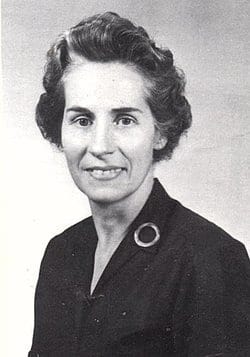
Most of us who knew her simply called her “Miss Law”. She was the mannerly and dignified teacher of direct objects, pronouns, and participles (“Don’t dangle those participles!”). She taught us to avoid run-on sentences like the plague, and with the precision of a skilled surgeon, she would wield her red pen while reviewing our research papers. As students, we knew bits and pieces of her life, but not as much as we wondered. We assumed that teachers mostly spent their spare time grading papers and plotting revenge on the students that caused them trouble in class. It was often a surprise to discover that teachers had other pursuits and that they might go to the grocery store just as we did. For Miss Law, it seemed her life centered around school and church, with perhaps a few parties and travel opportunities to break up the monotony. Most of us, as her students, had little inkling as to the extent of both tragedy and triumph in her life.
Her parents were married on the 6th day of October, 1917 in Westmoreland.
Odell Tilden Davis, “Professor Davis” as he would come to be called, was born near Epperson Springs in Macon County on December 9, 1875. His parents were Charles William Davis and Jemimah Gaines Davis. The Davis family was a farming family, and after a few years of this type of labor, Odell Davis decided on another calling. He took a course at the University of Tennessee in Knoxville and became a teacher. He returned to Macon County where he was teaching by 1910.

By 1920, Odell Davis was living in the 7th District of Sumner County, on Ketring Road, between Hendersonville and White House. He was 45 years old and teaching school in Cottontown. In the meantime, he had married Era May Hanes in October of 1917. She was born in Macon County on December 22, 1884, and was a daughter of Benton Ray Hanes and Melissa Ann Blankenship. At the time of their marriage, Odell was just shy of his 42nd birthday and Era was about to turn 33 years of age. Though the couple did not marry until well into adulthood, they had actually been closely acquainted with each other for a number of years. In 1901, they appeared together in a photograph of the “Westmoreland String Band”. In the picture, a mustachioed Odell Davis is holding a fiddle while Era Hanes is pictured holding a guitar. Perhaps already smitten, Odell is holding the fiddle under his chin but appears to be looking down in the direction of his future bride. A young Erb Hanes, brother of Era, stands behind his sister, while Estell Davis, a brother to Odell, sits in front of his brother holding an autoharp.


Marguerite Frances Davis, our “Miss Law”, was born into this talented family of musicians on September 17, 1920, in Westmoreland. A scant three years would pass in the young life of Marguerite Frances when the little girl would lose her mother.
Her mother was described in her obituary as being, “notably kind and considerate” and “a source of pleasure and happiness in her home.” Era Hanes Davis was first diagnosed with her illness in 1919, just two years after her marriage. Dr. T. Y. Carter began treating her then for tuberculosis. The “white death”, so-called due to the paleness of the patient’s complexion caused by the wasting of tissue, was a sentence of death to its victim, and though it would take three years of increasingly frail health, the relentless disease robbed Era Davis of her “bright, sunny disposition” and carried away her last breath at 9 pm on a Wednesday evening in late May of 1923. It was the first of a handful of tragic deaths in the life of “Miss Law” that would find her mourning at a grave in Pleasant Grove.
After the death of his wife, Professor Odell Tilden Davis was left with the task of raising his young daughter. Though he was an educator of children, he soon found the responsibilities of fatherhood more difficult than he presumed. He was elected as an alderman in Westmoreland in 1925 and was teaching school in the community that same year, but he left young Marguerite in the care of her mother’s parents at their Trammel Creek home. The decision had to have been one of great heartache for the kindly professor, for he was not an individual prone to dereliction. The 1930 census lists Marguerite as a resident in the household of her grandparents in Macon County. Also living in the blended household are two folks who would become most beloved to Marguerite…Erb and Calcie Hanes. Erb was the surviving brother of Marguerite’s mother.
The making of music was an important pastime in the Hanes household and Marguerite soon found herself playing the piano, just as her mother had done. Impromptu concerts filled the halls of the rambling house, and the sprawling shade trees of the front yard offered an open invitation to an evening’s soiree. Unable to take the piano outside on such occasions, Marguerite soon mastered the accordion. Though without her parents, Marguerite felt deeply loved by her extended family and cherished warm memories of her days at the Trammel Creek home.

At some point during this self-imposed sojourn, Odell Davis received an offer from Alvin York to come teach at his newly-formed Institute in Fentress County, Tennessee. Alvin York was the famous Sgt. Alvin C. York, hero of World War I, and was dedicated to the cause of education in his Jamestown community. Though her father’s tenure there would prove to be brief – the school suffered continuous financial problems – Marguerite fondly recalled occasional visits with her father in Jamestown and walking hand-in-hand with him along the streets of the small community.

Professor Davis would soon leave the Institute in Jamestown – with an autographed book from Sgt. York and a photograph of the soldier bearing the words, “To my Good Friend, ‘Prof’ Davis” – and return to Sumner County where he would be promoted to become the first Supervisor of Sumner County Schools. Prior to this, the tenure of Professor Davis had included Gumwood School in Macon County (where he had been Marguerite’s first teacher), and Shackle Island, Westmoreland, and others in Sumner County.
His return from Jamestown was perhaps hastened by the development of worrisome physical symptoms. Professor Davis had begun to suffer from unexplained episodes of numbness, slurring of his speech, increasingly severe headaches, and so forth. A review of his symptoms by his close friend and confidant, Dr. T. Y. Carter, caused great concern for the doctor, leading to a trip to Nashville and the surgical removal of the tumor that had formed in the brain of Odell Davis. Such procedures then were risky, at best, and often led to further complications. Recovery was slow and fitful and Professor Davis depended upon the use of crutches for mobility, but Marguerite noted many years later that the concept of being “handicapped” was “glossed over” by her father as he continued to perform his duties as school supervisor and father. Alas, however, his health once again began to deteriorate. A final operation proved to be unsuccessful in removing the reinvigorated tumor, and two weeks later, at 9:45 in the evening, on Valentine’s Day, 1932, Professor Odell Davis passed away at the home of his brother, Estell Davis, near Westmoreland. A day later, Marguerite, now eleven years old, again stood in the graveyard at Pleasant Grove and mourned the loss of her father – her “Daddie”.
Shortly after his death, Marguerite was given a letter addressed to her with the message, To be given her when I am gone. Written eight months earlier, “Daddie” wanted one last opportunity to offer words of wisdom and love to his daughter, his “Kiddie”:


Though orphaned, Marguerite was not without love, as her grandparents – her “Pappy and Mammy Hanes” – and her Aunt and Uncle, Calcie and Erb Hanes, would ably serve as guiding lights in her life, seeing to it that the values cherished by her deceased parents flourished in the girl. A proper education continued to be of great importance as witnessed by her graduation from Westmoreland High School in 1939. She was active in her church and she maintained absolute faith in the will of God in her life.
And she continued to adhere to her musical roots.
At the age of 17, Marguerite became a member of the country music group “The Dixie Red Wings”. Adeptly playing the accordion, she traveled with the band for performances throughout the area and performed each Saturday night on WSIX Radio and its live broadcast of the “Old Country Store” from the Andrew Jackson Hotel in Nashville.


Though the Dixie Red Wings would perform under that name for a few years, two of the performers went on to storied careers in the entertainment industry, and both had their beginnings in the Westmoreland area. Carl Mayes became a renowned news anchor in Charlotte, North Carolina from 1952 to 1988. There, he was the face of nightly news on television stations WBTV and WSOC. He was inducted into the Country Radio Hall of Fame in 2002. Scottsville native Jimmy Jones toured with various gospel music groups including the Deep South Quartet, the LeFevres, the Heralds, and the Sunshine Boys. He frequently appeared on Gaither Homecoming videos, received a Grand Ole Gospel Reunion Living Legend Award, is a member of the Georgia Music Hall of Fame, and the Southern Gospel Music Hall of Fame. And both were members of Westmoreland’s Dixie Red Wings with Marguerite Davis Law.

In 1938, another up and coming band arrived in Nashville, this time from the mountains of East Tennessee. Roy Acuff and his Smokey Mountain Boys were destined to become legendary in music circles, but on one particular Saturday night, Roy attended the “Old Country Store” performance before going to his own performance at the Grand Ole Opry. While sitting in the audience, he witnessed Marguerite and the Dixie Red Wings. After their performance, Acuff approached Erb Hanes and asked him to consider allowing Marguerite to join the Smokey Mountain Boys. A few weeks later, Roy Acuff and his wife traveled to Westmoreland and visited with the Hanes family hoping his band would add a particular accordion player to their lineup. Though flattered with the acknowledgement of her talent, Erb and his father, Benton, noted that Marguerite was about to start college and kindly turned down Acuff’s offer.
Though the opportunity at musical fame would pass her by, Marguerite soon set sail toward a career in teaching, following in the footsteps of her beloved father. This journey took her first to Pulaski, Tennessee and its Martin Methodist College, a four-year boarding college for women. She spent a semester there before transferring to Western Kentucky University in Bowling Green. The following years of her pursuit of a degree were spent studying at Austin Peay State University.

By all accounts, Marguerite enjoyed her stint at APSU. She was housed in the women’s dormitory, Harned Hall, which, during the war, also served as a barracks for naval cadets. World War II was raging and, with the nation at war, the branches of service were housing young trainees in many strange places. The housing of these young men in a women’s dormitory was not without concern from university officials and great efforts were made to keep the soldiers apart from the girls. The USO dances were regularly held and the girls served as hostesses and dancing partners. It was a jovial time stateside, belying the horrors of war to be witnessed by many overseas shortly thereafter.
In one letter written at the time to her Aunt Calcie, Marguerite noted she was writing at 11:45 pm on a Friday night and stated, “Perhaps you wonder what I’m doing up this time of the night. Well, the party is just over. I had a good time. 25 soldiers came from the Camp and there were plenty of partners. My dress was pretty & I got along o.k. only my “corny” toe hurt, ha!”
In the same note, she went on to reference “the letter I got this afternoon from Joe.”
Apparently, a great length of time had passed since she had last heard from “Joe” – “I had about decided Joe wasn’t going to write anymore. Poor guy.” – and during that period of absence, another individual, “Gilliam”, had sought to court Marguerite. But, alas, “Gilliam” was destined to be the “poor guy”. Marguerite announced to Aunt Calcie, “Gilliam got mad when he heard Joe’s letter called out this p.m. So we fussed tonight. First of all, he wants to give me a ring Christmas and I said positively no. (I don’t want another one to send back maybe).”
Perhaps we’ll never know the identity of “Gilliam”, but “Joe” was Joe Young Law, the Commander of USS PC 599, a submarine chaser. Joe was, at the time, stationed at the Quincy Adams Yacht Yard, hence his absence of letters to Marguerite. In fact, Joe had written many letters to Marguerite but letters from soldiers were often delayed.
At the end of her letter to Aunt Calcie, Marguerite expressed the consternation she felt in having two suitors, stating, “Shoot! I decide sometimes. I’m all messed-up.”
In his letter to Marguerite, Joe Young Law noted the work he was doing 12 to 14 hours per day, leaving him no time to “get to town” to purchase gifts for his family. He felt sure enough with his relationship with her to ask Marguerite to purchase gifts for them in his absence. He also wanted to know what she might like, as well, and requested only some cookies from her, or “something like that better than anything”.
Joe Young Law was born on January 5, 1916, the youngest child of Bearl Addison “Dink” Law and his wife, Martha Susan Sanders Law. His family lived in the western edge of Macon County, just down the road a piece from Benton Hanes and the shaded lawn of Marguerite’s childhood concerts. The two families were well-acquainted with each other, and the future couple, as children, attended school together at Gumwood School a short distance from their houses.
Joe Young Law signed his draft card in Lafayette on October 16, 1940 and joined the US Navy on August 20, 1941, nearly four months before the attack on Pearl Harbor. As noted earlier, he would eventually become the Commander of PC 599, a submarine chaser, and saw service in the Pacific from 1943 to the end of the war, eventually discharging from the service into the Naval Reserve. Like many at the time, he furthered his education under the G. I. Bill.


As the war continued, so did the courtship between Marguerite and Joe so that, by the end of the conflict and Joe’s return home, they were married. The clipping above stated the two were married on Dec. 21, 1945 “at the home of the officiating minister, the Rev. W. E. Doss.” However, that was not quite accurate. The young couple got their wedding license at the Davidson County Courthouse in Nashville. When they arrived at the home of Rev. Doss in Gallatin to hold the brief ceremony, the minister reminded them of state law at the time which required the ceremony to be performed in the county that issued the marriage license. Laughing off the dilemma, the wedding party piled into cars, zipped down the Nashville Pike through Hendersonville, and then crossed Manskers Creek into Davidson County where they promptly pulled into a parking lot to perform the legal ceremony. They then returned to the Doss home in Gallatin for the traditional event. In both ceremonies, Reeves Simmons Maggart served as the lone bride’s maid.
As the wedding announcement noted, both Marguerite and Joe were teaching at Westmoreland High School. Joe taught science, history, and economics, while Marguerite was teaching English. Marguerite would go on to make a career of it, becoming the beloved “Miss Law”, while Joe would only teach briefly, choosing, instead, to serve briefly as the Town Recorder for the City of Westmoreland, and then becoming one of the area’s rural mail carriers.

The young Law family settled in Westmoreland on Sumner Drive next door to the Mandy Word family. Within a few years of their wedding, the couple had added two baby girls to their family. By 1950, Joe was the Assistant Foreman at the Kraft Cheese Factory in Gallatin. Marguerite had temporarily left her teaching position to become a stay-at-home mom, raising their growing family; sisters Rose and Jo had been joined by a third sibling, another girl, Lucinda – Cindy – in January. Eventually, a fourth child, Harry, named for his father’s brother, would join the trio of daughters. Theirs was a family that placed great importance on the value of an education and on the importance of a moral compass in life. Their lives centered around school, their church, extended family, and a strong network of friends. Marguerite knew well the value of such anchors in times of crisis, but she had no inkling as to the degree she would soon be forced to depend on each for the survival of her family.

In the summer of 1959, Joe and Marguerite announced to their children they would take a vacation. It would be their first vacation to a “far off place”; they would leave at the end of June and travel to Panama City Beach, Florida. The kids eagerly anticipated the trip, looking forward to the journey, the sand, and the waters of the Gulf of Mexico. In the meantime, Joe regaled them with stories of his adventures on the ocean, serving to further build their eagerness for the adventure.
When the day of departure, June 29th, finally arrived, the family of five climbed into their car, waved their excited goodbyes to family and friends, and proceeded down Highway 231 to their coastal destination. Along the way, excited chatter about sights and towns never before seen eventually gave way to catnaps and the inevitable “are we there yet?” Stops along the way were hurried in eagerness to plant their toes in the sand before nightfall. As was his habit, Joe smoked many a cigarette on the journey, and Marguerite led the family in songs and car games to make the trip go by faster for all. Joe laughed and sang along with his family but informed Marguerite of some dull pain in his left arm, a sensation he attributed to arthritis and the long day of driving.
Finally, in the early evening with plenty of Florida’s sunshine remaining in the sky, the car came to the end of Hwy 231 in Panama City Beach and Joe soon found himself at the front desk of the complex of tourist cabins where the Laws would stay. A quick placing of their luggage in their assigned cabin gave way to hurried donning of swimwear and the family seeing the expansive Gulf for the first time. All were quickly in the water, save for Marguerite, who kept a watchful eye on her brood as they frolicked in the surf. Joe, an expert swimmer from his Navy days, had swam quite a distance from the shore. After a while, Marguerite lost sight of him as he was returning to the beach. Scanning the area, she called out to her daughter, “Rose, I don’t see your father.” Rose soon pointed and replied, “I see the top of his head!”
When he didn’t come to the surface, Marguerite screamed and ran toward the ocean. She didn’t get far when two men ran past her and told her they would go to her husband. Marguerite and her children watched as the men retrieved Joe from the ocean and began working on him as he lay on the beach. The wives of the two men attempted to console the panicked and frightened family as an ambulance soon arrived, quickly taking Joe and Marguerite, who climbed into the back with her husband, to the hospital.
Back at the cabins, the children anxiously waited with the families who had rescued their father. They were from Michigan and the Law children never forgot the kindness shown them by these strangers as the hours ticked by. Eventually, Marguerite returned to the cabin and reported to her children that their father was gone.
Folks back in Westmoreland were shocked upon hearing the news of the death of Joe Y. Law.
Joe had been a member of the Masonic Lodge, so it’s members prepared for a Masonic Funeral for their lost brother.
He had been a member of the Westmoreland Methodist Church where he served as Sunday School Superintendent. Its members began planning for their participation in the funeral of their beloved brother and the mourning of his loss and what that would mean to his wife and children.
As a rural mail carrier for the Westmoreland Post Office for the past few years, Joe Y. Law, would be regularly greeted by many of his patrons at their mailboxes out in the countryside. These customers were saddened at the loss of their friend.
And the family of Westmoreland High School, were Marguerite had resumed her teaching of English in 1954, was heartbroken at the news of the loss of a former teacher and dependable patron.
And those circles of friends came together in support of the young family who had lost their beloved husband and father.
Immediately upon hearing the news, brothers Johnnie and Jimmy Law, along with Johnnie’s wife, Sarah Law, and Marion Doug Kirby, the wife of H. G. Kirby, drove to Panama City. They knew Marguerite was in no condition to drive the family car back to Westmoreland. The children recalled arriving back in Westmoreland late at night on the day following their father’s death, and being quite surprised to find the lights were all on and that many neighbors, friends, and family members were present. When the three girls finally went to bed that night, they were joined by their friend and neighbor, Reba Anderson (Troutt).

Joe Law had been a reasonably good swimmer, a reasonable presumption with having served in the Navy for so many years. The police speculated, as stated in the obituary, that he had been caught in an undertow. The family often speculated the cause of death could have been a heart attack. As noted earlier, he had been complaining of achiness in his left arm on the trip to Panama City Beach, and he had been a heavy smoker for years. Whatever the cause, Marguerite once again found herself mourning at the grave of a close loved-one at Pleasant Grove, this time with her four children beside her.
The Sunday that followed, Marguerite did not take her usual place at the organ of the Westmoreland Methodist Church. Instead, she sat quietly with her children in the back. Though her heart had once again been broken, she chose to stoically bear the burden of loss and to remain strong for the children she and Joe brought into the world. She would pour herself into activities at the church, teaching Sunday School, playing the organ, serving on committees, and making and delivering meals to families in need “out in the countryside” on Saturdays, asking her children, “Who wants to ride with me?”.
She did the same at WHS, still teaching English until her retirement in 1981. She would play religious songs at the baccalaureate service held the Sunday before graduation up until the mid-1970s. And, in the years before WHS had a band, she would play “Pomp and Circumstance” at the school’s graduation. She directed school plays and sponsored various clubs, attended most ballgames, and was active on many school committees. She devoted countless hours to making lesson plans and grading papers, and thoroughly embarrassed her children when they were in her class by running over and opening a window during the reading of Romeo and Juliet, calling out, “O Romeo, Romeo! Wherefore art thou, Romeo?”
The house on Sumner Drive proved too difficult for her to remain there; memories of better times with Joe lingered too deeply there and she chose to build a new house on a small tract of land in downtown Westmoreland next to the Westmoreland Church of Christ. The land was given to her by her Uncle Erb. His wife – Marguerite’s “Aunt Calcie” – died a little over a year after the death of Joe, and his eyesight was failing, so Marguerite thought it best to be near the man who had become a father figure to her after the death of her own father back in 1932. Erb’s house stood in the lot beside her newly built house.

Every night until near his death in 1973, Uncle Erb would take his supper at the table of Marguerite and her children. And as he had done with her, Erb became a fatherly figure for her children, especially Harry, who would spend many days and evenings sitting on the porch in conversation with with the elderly man.
Though they never spoke of it to her, the four children recalled frequently hearing their mother softly crying at night, alone in her bedroom. Through it all, she honored her lost husband, often identifying herself as “Mrs. Joe Y. Law” in official correspondences.
To those of us who were fortunate enough to sit in her English classes at WHS, she was always the smiling, gentle soul who commanded our respect and attention, occasionally admonishing, “Boys and girls, in a nice way, shut up!”. And, that we did. She always had a kind heart and looked out for those who might be in need. She made sure the Student Council contributed to the Second Harvest Foodbank in Nashville each Thanksgiving, and she regularly took students under her wing, pushing them to do better and seeing to it their material needs be met, if necessary. Future television news anchor Allen Denton recalled, “the saintly, beloved Mrs. Law believed in me when few others did,” by allowing him to re-take a final exam in Senior English that he had failed. Without the second chance, he would not have graduated. She told him to study “specific chapters, and to study hard”. He did, and passed, and accepted his diploma a few days later, eventually going on to a distinguished career in broadcast journalism.

And, as a single mother, she raised her four children, seeing to it that each of them were college-bound after their graduation from high school. All four became successful in their chosen careers and attribute much of their success to the guiding hand of their mother.
After her retirement, she sometimes fell into mischief as old folks are prone to do. After she moved from Westmoreland to an apartment in Hermitage, Tennessee, she would often come “back home” for visits with friends and relatives. Eventually, her driving skills began to wane, and her children asked her to not go anywhere without them. She promised to do so, but headed north one day anyway. In the days without cell phones, her children, not knowing her whereabouts, began calling folks in Westmoreland. They found the answer from all was pretty much the same, “She was here visiting with us for a while, but we don’t know where she is now.” Finally, it was decided to simply await her arrival back at her apartment. When she finally arrived, she sheepishly explained all the duties she had to perform that day, the last that she would take without her children driving her.
In 1994, when the Westmoreland Chamber of Commerce was given the task of choosing a local resident to be selected as its first “Citizen of the Year”, I, as the organization’s president, nominated my former English teacher for the honor. “Miss Law” was the unanimous choice of the full board of directors.
She became a world traveler and always held that her favorite place to visit had been the Holy Lands. Her 80th birthday was celebrated flying over Westmoreland, riding as co-pilot with Jerry Kirby. Diagnosed with esophageal cancer in 2003, she took one last trip to Gatlinburg. There, she enjoyed challenging a Bluegrass band to play old tunes that she had performed so many years earlier on those Saturday nights at the Andrew Jackson Hotel in Nashville, and she mused that she would never see those mountains of East Tennessee in this life again.
Her journey of perseverance and resilience against adversity came to an end a few days before Thanksgiving in 2003. Mrs. Joe Y. Law – our “Miss Law” – was laid to rest next to her beloved husband at Pleasant Grove a few days later.

10 responses to “Marguerite Davis Law…a community’s beloved English teacher”
Thank You. Such a wonderful tribute to Miss Law. I never gave thought to her history when I had her class. I wish I had the curiosity (as a young person) that I have now. Our past is so full, but some, like I, will never know it.
Phyllis, thank you for reading! I knew bits and pieces but had no idea as to the extent of the obstacles she had to overcome. She was a very strong person.
Story so well done. What a great teacher she was.
Thank you and glad you liked reading it!
Enjoyed reading this. Small world. My Dad, Robert Shannon taught Ag at Westmoreland High about 1943-45. He and my Mom, Mary Russell Holmes Shannon, rented the house on Sumner next to Mrs Word and my sister Mary was a baby born in 1944. I always laughed with my Mom when I found out that in a side room of the house they were storing funeral home caskets in there. I had the fictional vision of Moms good China stored in those caskets . Ha
Fact is often stranger than fiction! Glad you enjoyed reading about Mrs. Law and thank you for the comment.
Oh my goodness. You nailed her story. The only thing you left out was Harry was run over by Garland Harper’s son Jamie Harper I think was his name. It was summer and he was crossing 52 and there was a slight hill and He said he did not see him. Harry was hurt really bad. He was crossing to come and play with us in my grandparents yard. We all saw it happen. It was so bad, but he finely got well.
I did not know this about Harry. I know the spot in the road where he would have crossed near your grandparent’s at the top of the hill. Definitely a blind spot there. Thank you for the comment and adding to the story!
Thank you John. She had a remarkable life
Thank you!